
If you have been doing SEO for any length of time, you have probably heard the term link sculpting thrown around — often alongside words like PageRank, link juice, and nofollow. But here is the problem: most of what you will read about link sculpting online is either outdated, flat-out wrong, or based on a version of Google’s algorithm that stopped working in 2009.
- What Is Link Sculpting?
- The History of Link Sculpting: Old Method vs Modern Method
- The Old Method: PageRank Sculpting with Nofollow (Pre-2009)
- The Modern Method: Strategic Internal Link Architecture
- How Link Equity Actually Works in 2026
- The Crawl Budget Connection
- 7 Core Link Sculpting Techniques for 2026
- 1. Build a Clear Pillar and Cluster Architecture
- 2. Identify Your Highest-Authority Pages and Use Them as Link Sources
- 3. Use Descriptive, Keyword-Rich Anchor Text
- 4. Reduce Orphan Pages
- 5. Fix Deep Pages With High Click Depth
- 6. Use Contextual Links Over Navigation Links
- 7. Consolidate Thin Pages with Redirect Chains
- Link Sculpting vs Tiered Link Building: What Is the Difference?
- How Buying Backlinks Connects to Link Sculpting
- Link Sculpting for Backlink Services and Agency Sites
- Link Sculpting Tools
- Common Link Sculpting Mistakes to Avoid
- How to Audit Your Current Link Sculpting Structure
- Does Link Sculpting Still Work in 2026?
- Link Sculpting for Different Types of Sites
- Internal Linking Frequency: How Many Links Per Page?
- Summary: Link Sculpting Best Practices
- Frequently Asked Questions About Link Sculpting
This guide cuts through all of that noise.
We are going to cover what link sculpting actually means in 2026, how the old method died and what replaced it, and give you a clear, practical strategy you can start applying to your site today to improve rankings, crawl efficiency, and internal authority flow.
Whether you are managing a small affiliate blog or a large e-commerce site with thousands of pages, link sculpting is one of the highest-leverage internal SEO tactics available to you — when done correctly.
What Is Link Sculpting?
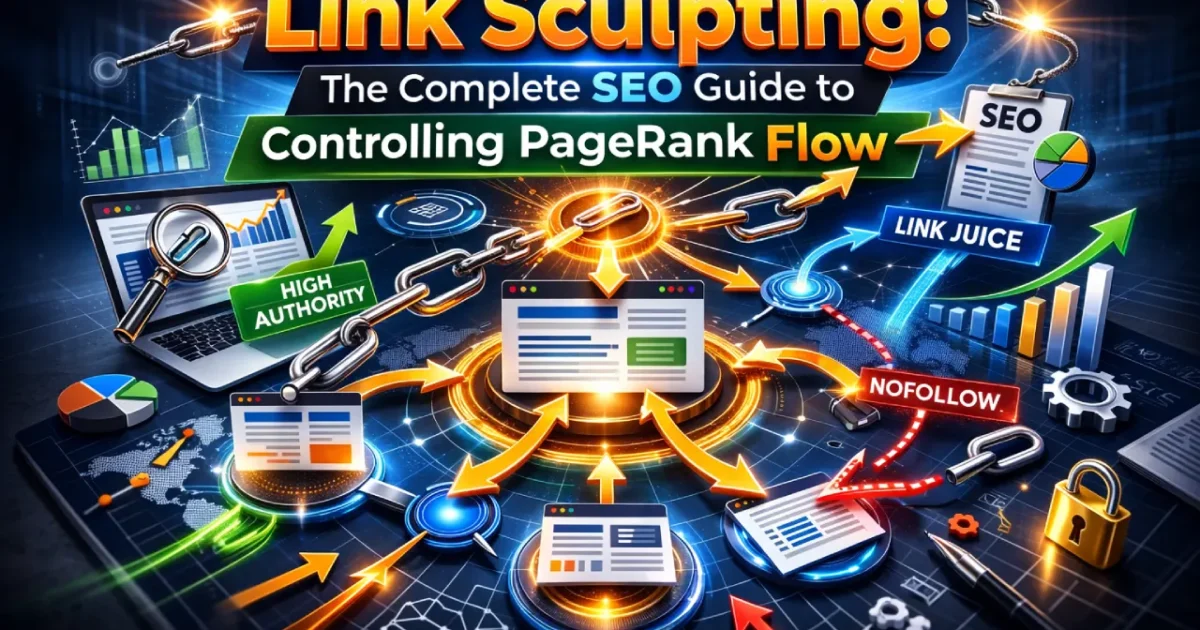
Link sculpting is the practice of strategically controlling how link equity (also called link juice or PageRank) flows through your website from one page to another. The goal is to concentrate ranking authority on the pages that matter most — your money pages, pillar content, and conversion-focused landing pages — while minimising wasted authority on pages that do not contribute to your SEO goals.
In simple terms: every page on your site has a certain amount of authority, and every internal link you place transfers some of that authority to the linked page. Link sculpting is the discipline of deciding intentionally where that authority goes, rather than letting it distribute randomly based on however your content happened to be structured.
Think of it like water in a plumbing system. Without link sculpting, authority leaks equally in every direction. With a properly sculpted internal link structure, you direct the flow where it delivers the most ranking value.
The History of Link Sculpting: Old Method vs Modern Method
To understand how to use link sculpting correctly today, you need to understand the two distinct eras of this tactic — because confusing them is the most expensive mistake SEOs make.
The Old Method: PageRank Sculpting with Nofollow (Pre-2009)
The original version of link sculpting — sometimes called PageRank sculpting — relied on a simple idea: if a page had 10 outgoing internal links and you added rel=”nofollow” to 5 of them, the PageRank that would have flowed through those 5 links would instead be redistributed to the remaining 5 dofollow links, giving each one a larger share of authority.
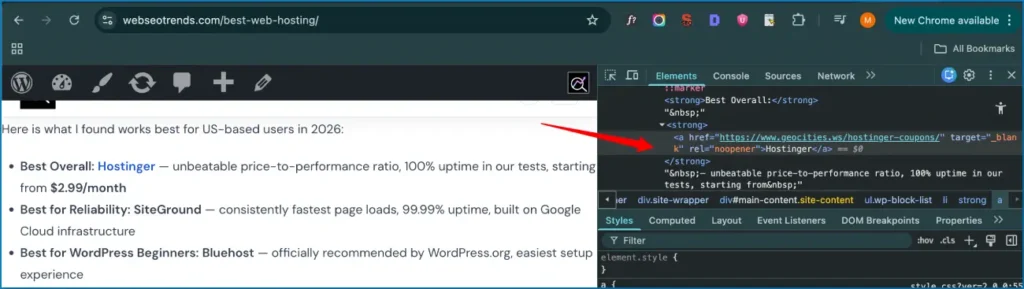
This was a legitimate technique for several years and it worked well. SEOs would nofollow their terms and conditions pages, login pages, contact pages, and other low-value internal pages to concentrate PageRank flow on their most important content.
Then in June 2009, Matt Cutts of Google announced a critical change to how nofollow was handled internally. The announcement confirmed that PageRank no longer redistributes when a link is nofollowed. Instead, the authority that would have flowed through that nofollow link simply evaporates. It disappears entirely.
This single algorithm change killed the original PageRank sculpting model overnight. If you nofollow a link today, you do not redirect that authority to your other links — you simply waste it. You lose that portion of authority permanently.
Any link sculpting strategy still built on the old nofollow redistribution model is not just ineffective — it is actively costing you authority every time you nofollow an internal link unnecessarily.
The Modern Method: Strategic Internal Link Architecture
Modern link sculpting has evolved into something far more sophisticated and far more aligned with how Google actually evaluates sites today. It is no longer about adding and removing nofollow tags. It is about designing your internal linking architecture deliberately so that your most important pages naturally receive the most authority from internal signals.
Modern link sculpting combines three disciplines:
- Site architecture design — structuring your site hierarchy so that authority flows logically from high-authority pages downward to the pages you want to rank.
- Strategic internal linking — actively placing internal links from your highest-authority pages to your target pages using relevant, descriptive anchor text.
- Crawl budget optimisation — ensuring search engine bots prioritise crawling your most valuable pages by concentrating links and internal signals on them.
This modern interpretation of link sculpting is not a hack or a workaround. It is simply what good SEO site architecture looks like in practice. Once you have a strong link building strategy bringing authority into your site, link sculpting is the internal system that makes sure none of that authority leaks to pages that do not need it.
How Link Equity Actually Works in 2026
Before applying any link sculpting strategy, you need a solid understanding of how link equity flows in the current algorithm.
Every page on your site carries a certain amount of authority, derived from a combination of:
- External backlinks pointing to that specific page — the more high-quality referring domains pointing to a page, the more authority it starts with.
- Internal links from other pages on your site — each internal link passing authority to the target page proportionally based on how many outbound links the source page has.
- Site-wide authority — your overall domain-level authority (DR in Ahrefs, DA in Moz) creates a baseline of authority that distributes across your entire site.
When a page has many internal links pointing to it from authoritative source pages, it accumulates more link equity. When a page sits deep in your site architecture with few internal links pointing to it, it receives very little authority — regardless of how well-written the content is.
This is why backlinks still matter as the starting point — they are what brings authority into your domain in the first place. But as we explain in our guide on why backlinks still matter and how to build quality links, earning those links is only half the job. The other half is making sure your internal structure distributes that authority correctly through link sculpting.
The Crawl Budget Connection
There is a second, often overlooked reason why link sculpting is so important: crawl efficiency. Search engine bots do not have unlimited time or resources to crawl every page of your site on every visit. They allocate crawl budget based on signals — and internal links are one of the strongest signals for which pages deserve priority crawling.
Pages with more internal links pointing to them get crawled more frequently. Pages buried deep in your architecture, accessible only through 4 or 5 clicks from the homepage, get crawled infrequently or sometimes not at all.
By sculpting your internal links to concentrate on priority pages, you are also telling search engines to crawl those pages more frequently — which means faster indexing of updates and faster recognition of new content.
7 Core Link Sculpting Techniques for 2026
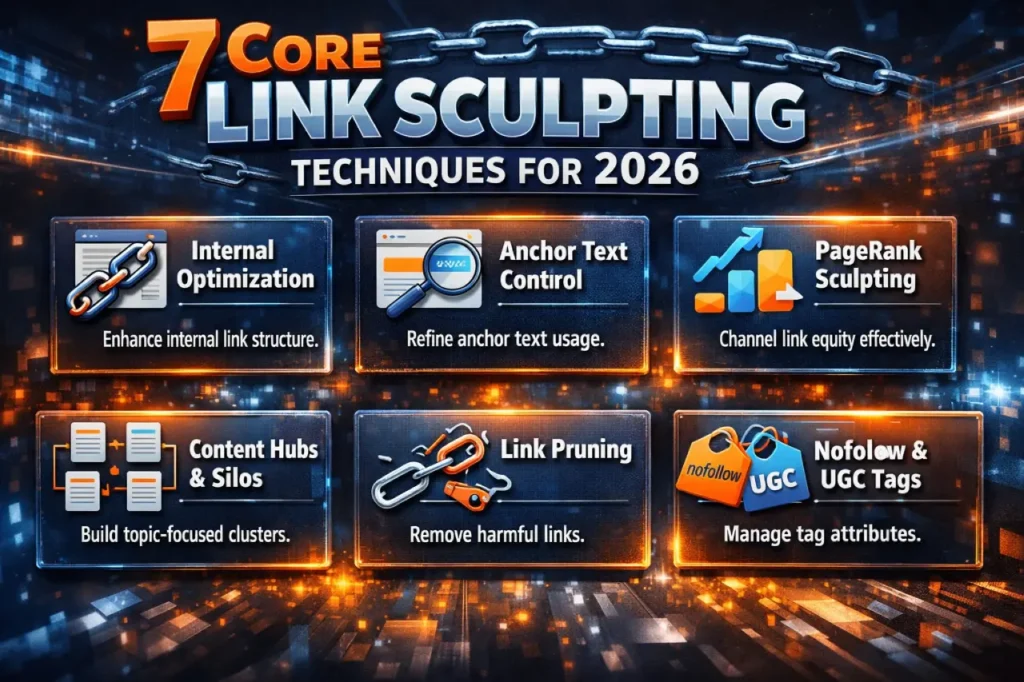
Now let us get practical. Here are the seven link sculpting techniques that consistently deliver results in the current SEO environment.
1. Build a Clear Pillar and Cluster Architecture
The most foundational link sculpting structure in modern SEO is the pillar page and content cluster model. A pillar page is a comprehensive, high-authority page covering a broad topic. Cluster pages are more specific pieces of content covering subtopics within that broader theme. Every cluster page links back to the pillar, and the pillar links out to each cluster.
This creates a dense, reciprocal internal linking loop where authority flows both ways — your pillar page concentrates authority from all cluster links pointing back at it, and your cluster pages each benefit from the authority passed down from the pillar.
For a link building focused site, a pillar page on “link building” would link to cluster pages on backlink audits, link insertion services, manual link building, EDU backlinks, and more — each of which links back. This is link sculpting at the structural level.
2. Identify Your Highest-Authority Pages and Use Them as Link Sources
Pull your site’s data in Ahrefs or Semrush and sort pages by the number of referring domains pointing to each URL. The pages with the most external backlinks are your highest-authority source pages. These are your most powerful internal link-passing assets.
Any page you want to rank should be receiving internal links from these high-authority source pages. If your best-performing blog post has 40 referring domains and you have never added an internal link from it to your target page, you are leaving significant link equity on the table.
Audit your top 10 authority pages and ask: which pages on my site do not yet receive a link from here that should? Add those links with relevant, descriptive anchor text.
3. Use Descriptive, Keyword-Rich Anchor Text
Internal links are one of the clearest signals you can send to Google about what a target page is about. When you link internally to a page, the anchor text you use directly communicates topical relevance.
Generic anchor text like “click here,” “read more,” or “this article” passes zero topical signal. Descriptive anchor text like “link sculpting strategy”, “backlink profile optimisation”, or “manual link building service” tells Google exactly what the target page covers and reinforces its relevance for those terms.
Best practice for internal link anchor text in link sculpting:
- Exact match anchors — use sparingly (1–2 times across the site per target keyword) to avoid over-optimisation signals.
- Partial match anchors — phrases that include the keyword but with natural variation. Most of your internal links should fall here.
- Branded and navigational anchors — use naturally where they make sense.
- Topic descriptive anchors — longer descriptive phrases that describe what the user will find. These are safe to use frequently.
4. Reduce Orphan Pages
An orphan page is any page on your site with no internal links pointing to it. From a link sculpting perspective, orphan pages are invisible — they receive zero link equity from internal signals and are frequently missed by crawlers.
Identify orphan pages by running a site crawl in Screaming Frog or Ahrefs Site Audit and filtering for pages with zero internal links. For every orphan page you find, add at least 2–3 relevant internal links from pages that cover related topics.
Priority orphan pages to fix first: any page you are actively trying to rank, any page that has external backlinks pointing to it, and any page that generates revenue or leads.
5. Fix Deep Pages With High Click Depth
Click depth refers to how many clicks it takes to reach a page starting from your homepage. Pages at click depth 4 or higher receive significantly less crawl attention and internal authority than pages at click depth 1–3.
Use a site crawl to identify your most important pages that are sitting at high click depths. Reducing click depth — by adding links to these pages from your navigation, homepage, or high-authority hub pages — is one of the most impactful link sculpting actions you can take.
The ideal click depth for your most important pages is 2 or fewer. No money page or priority content should require more than 3 clicks from your homepage to reach.
6. Use Contextual Links Over Navigation Links
Not all internal links pass equal authority. Links placed within the body content of a page (contextual links) carry more weight than links placed in sidebars, footers, or navigation menus.
This is because contextual links are surrounded by relevant content that reinforces the topical connection between the source and target pages. A link in the middle of a paragraph about backlink management pointing to your backlink audit page sends a much stronger topical signal than the same link in a footer.
When link sculpting, prioritise adding contextual internal links within your content body rather than relying on navigation or sidebar links alone. Aim for at least 3–5 contextual internal links per piece of long-form content.
7. Consolidate Thin Pages with Redirect Chains
Every page on your site that has little or no value — thin content, duplicate content, outdated posts with no traffic — is diluting your overall site authority. These pages absorb crawl budget and contribute nothing to your PageRank flow model.
Identify low-quality pages using Google Search Console (pages with impressions but zero clicks over 12 months), then either consolidate them into stronger pages with 301 redirects or improve them with substantially more useful content.
As we cover in our guide on 301 redirect backlinks, a properly executed 301 redirect passes the majority of link equity from the old URL to the new destination — making it one of the most efficient tools in your link sculpting arsenal for consolidating authority from weak pages into strong ones.
Link Sculpting vs Tiered Link Building: What Is the Difference?
A common point of confusion is the difference between link sculpting and tiered link building. They are related but distinct strategies.
Link sculpting operates entirely within your own website. It is about how you distribute and direct authority between your own pages through internal links. You control every aspect of it.
Tiered link building operates externally. It involves building links to pages that link to your site — so a Tier 2 link points to a Tier 1 page, which points to your money page. The idea is to amplify the authority of your external link sources by pointing additional links at them. Web 2.0 properties are a popular Tier 2 vehicle for this — as covered in our guide to 50 free Web 2.0 blogging sites, these platforms can be used to build supporting authority around your Tier 1 backlinks before they pass equity to your domain.
Where they overlap: both strategies are fundamentally about controlling the flow of link equity and PageRank to the pages you want to rank. The tools and methods differ, but the underlying goal is the same — concentrate ranking authority on target pages.
The most effective SEO programs use both together. Link sculpting maximises the value of every external backlink your site earns by ensuring that authority flows efficiently to priority pages internally. Tiered link building amplifies the authority of those external links before they even reach your site.
How Buying Backlinks Connects to Link Sculpting
If you are buying backlinks or running an outreach campaign, link sculpting is what determines how much ranking value you actually extract from every placement you pay for.
When you buy backlinks from quality sources, the authority from those links lands on the specific URL being linked to. If that URL is poorly connected internally — few internal links pointing from it to your money pages, sitting at high click depth, isolated from your core content cluster — a significant portion of that authority never reaches the pages you actually care about.
This is why combining a deliberate backlink acquisition strategy with a link sculpting plan is so important. Before any link goes live, the target page should already have a strong internal link structure pointing from it to supporting pages, and internal links from your highest-authority pages pointing back to it.
The same principle applies to guest posts. A guest post backlink to your homepage passes authority site-wide, but a guest post backlink to a specific cluster page passes authority directly to that page and — through your link sculpting structure — to all the pages it links to internally. As we cover in our free guest posting websites guide, choosing the right target URL for each guest post placement is one of the most underused optimisation levers available in any outreach campaign.
Link Sculpting for Backlink Services and Agency Sites
If you are running a link building service or offering SEO as an agency, link sculpting should be part of every client onboarding conversation. Most clients focus entirely on the number and quality of links being built — and rightly so — but many see slower-than-expected results because their internal structure is not primed to receive and distribute that authority effectively.
Before any link building campaign begins, run a link sculpting audit on the client’s site. Identify the pages being targeted for rankings. Check how many internal links they currently receive. Check their click depth. Check whether your highest-authority client pages are linking to them contextually.
This pre-campaign internal audit is one of the services included in our premium backlink services — because we know that a well-sculpted internal link structure can double the ranking impact of every external placement we build.
Link Sculpting Tools
These are the tools used by SEO professionals for implementing and auditing link sculpting strategies:
- Screaming Frog SEO Spider — the industry standard for full internal link audits. Shows every internal link on your site, click depth for every page, and identifies orphan pages and redirect chains. Run this quarterly.
- Ahrefs Site Audit — excellent for identifying pages with low internal link counts, monitoring internal link growth over time, and finding internal linking opportunities based on topical relevance.
- Google Search Console — use the Links report to see which pages on your site receive the most internal links. The Coverage report surfaces pages not being crawled or indexed.
- LinkWhisper — a WordPress plugin that uses AI to suggest contextual internal link opportunities automatically across your existing content. Useful for scaling internal linking on large sites.
- Semrush Site Audit — provides internal link distribution scores, identifies internal link errors, and flags pages with insufficient internal links relative to their importance.
Common Link Sculpting Mistakes to Avoid
Even experienced SEOs make these mistakes when implementing link sculpting strategies.
Over-relying on nofollow for internal links — as covered earlier, nofollowing internal links wastes authority rather than redistributing it. Only use nofollow on internal links when you have a specific reason to exclude a page from indexing entirely (like a thank-you page or a login page).
Ignoring anchor text diversity — using the same exact-match anchor text for every internal link to a target page looks unnatural and can trigger over-optimisation signals. Vary your anchor text using partial matches, descriptive phrases, and natural language variations.
Building internal links only to new content — new content needs internal links, but so does your existing content. Run a quarterly internal link audit and add new contextual links to your most important existing pages as you publish new content.
Using generic or vague anchor text — “click here,” “read more,” and “this post” tell Google nothing about the target page. Replace these with descriptive phrases that reinforce topical relevance.
Not updating internal links as your content strategy evolves — a link sculpting structure built 12 months ago may no longer reflect your current priority pages. Audit and update your internal link map at least twice a year.
Linking excessively from low-authority pages — 20 internal links from a page with zero external backlinks contributes less than 3 internal links from your highest-authority page. Focus on quality of link source as well as quantity.
How to Audit Your Current Link Sculpting Structure
Before you change anything, run a full link sculpting audit. Here is the exact process:
Step 1 — Export your full internal link report from Screaming Frog. Filter to show only internal dofollow links.
Step 2 — Pull a list of your 20 most important pages — the pages you most want to rank. For each one, check how many internal links it currently receives and from which source pages.
Step 3 — Pull your top 10 authority pages by referring domains from Ahrefs. Check which of your priority pages they are currently linking to.
Step 4 — Identify the gap. Which priority pages have fewer than 5 internal links? Which priority pages are not being linked to from any of your top authority pages?
Step 5 — Create an internal link addition plan. For each priority page with insufficient internal links, identify 3–5 existing pages that could naturally link to it and draft contextual sentences to add those links.
Step 6 — Identify orphan pages and high click depth pages for cleanup or consolidation.
Step 7 — Implement changes and rerun the Screaming Frog audit in 30 days to verify improvements.
This audit cycle, done quarterly, is the backbone of a long-term link sculpting strategy.
Does Link Sculpting Still Work in 2026?
Yes — unequivocally. But the version that works in 2026 looks almost nothing like the nofollow PageRank sculpting that dominated SEO discussion before 2009.
Modern link sculpting works because it aligns directly with how Google evaluates and rewards sites:
Google values pages that are easy to crawl and index. Link sculpting improves crawl efficiency by concentrating internal signals on priority pages.
Google rewards pages with strong topical relevance signals. Link sculpting with descriptive anchor text reinforces topical connection between related pages.
Google evaluates authority at the page level. Link sculpting ensures your high-authority pages pass equity efficiently to the pages you want to rank.
Google rewards good user experience. A well-sculpted internal link structure naturally guides users to the most relevant content — which reduces bounce rate and increases engagement signals.
Case studies and controlled SEO tests consistently show that systematically improving internal link distribution to target pages produces measurable ranking improvements within 4–8 weeks, even without building new external backlinks. For sites with existing authority, link sculpting is frequently the fastest path to ranking improvement with the least external resource investment.
Link Sculpting for Different Types of Sites
- E-commerce sites — link sculpting is critical for product category pages. Link from blog content and buying guides to category and product pages using keyword-rich anchor text. Prioritise your highest-margin categories as link targets.
- Blogs and content sites — use pillar and cluster architecture. Every cluster post should link back to its pillar page. Pillar pages should link to all major clusters. Add contextual links from your highest-traffic posts to your highest-priority target pages.
- Service and agency sites — every blog post you publish should include at least one internal link to your core service pages. Use anchor text that matches the commercial keywords those service pages target.
- Local SEO sites — link sculpting for local sites should concentrate authority on location-specific pages. Link from blog content to service area pages and from your homepage to your most competitive local landing pages.
Internal Linking Frequency: How Many Links Per Page?
There is no perfect number, but here are the practical benchmarks based on current best practices:
For long-form content (1,500 words or more): aim for 4–8 contextual internal links per piece. Fewer than 3 misses opportunities. More than 10–12 starts to feel unnatural and dilutes the authority passed per link.
For short-form content (under 1,000 words): 2–4 internal links is appropriate.
For homepage and pillar pages: link to every major cluster page and service page in your architecture. These hub pages can support 10–20 internal links without issues because of their structural role.
The key rule: every internal link should be contextually relevant and genuinely useful to the reader. If you are adding links purely for link sculpting purposes with no relevance to the surrounding content, they will not perform as well and may look unnatural to Google’s quality assessors.
Summary: Link Sculpting Best Practices
Link sculpting in 2026 is a modern, user-centric discipline — not the PageRank manipulation tactic it once was. Here is a concise summary of the principles covered in this guide:
The old nofollow PageRank sculpting model is dead. Do not add nofollow to internal links to “redirect” authority — it destroys that authority instead.
Modern link sculpting is about intentional site architecture, strategic internal linking, and deliberate anchor text selection.
Build your site using a pillar and cluster model where authority flows efficiently between related pages in both directions.
Identify your highest-authority source pages and use them to pass link equity to the pages you want to rank.
Use descriptive, keyword-rich anchor text for every contextual internal link. Avoid generic phrases.
Eliminate orphan pages and reduce click depth for your most important content.
Run a quarterly internal link audit using Screaming Frog and Ahrefs to identify gaps and opportunities.
Combine strong link sculpting internally with high-quality external backlink acquisition for the fastest and most sustainable ranking results.
Frequently Asked Questions About Link Sculpting
Q: What is link sculpting in SEO?
A: Link sculpting is the practice of strategically controlling how link equity (PageRank or link juice) flows through your website via internal links. The goal is to concentrate authority on your most important pages — such as money pages, pillar content, and service pages — to improve their rankings in search results.
Q: Does link sculpting still work in 2026?
A: Yes. Modern link sculpting — based on strategic internal linking and site architecture rather than nofollow manipulation — is one of the most effective internal SEO techniques available. It directly improves crawl efficiency, topical relevance signals, and page-level authority distribution.
Q: What is the difference between link sculpting and PageRank sculpting?
A: PageRank sculpting refers to the older technique of using nofollow attributes on internal links to redirect PageRank flow to priority pages. This stopped working after Google’s 2009 algorithm change. Link sculpting today refers to the broader, modern discipline of managing authority flow through intentional site architecture and internal linking strategy.
Q: Can I use nofollow for link sculpting?
A: No — not in the traditional sense. Since 2009, nofollowing an internal link causes the authority that would have passed through that link to disappear entirely. It is not redistributed to other links on the page. Only use nofollow on internal links when you genuinely want to exclude that page from search engine consideration (such as login pages, thank-you pages, or cart pages).
Q: How do I know which pages to prioritise in my link sculpting strategy?
A: Start with the pages that generate revenue or lead conversions — your service pages, product pages, and high-intent landing pages. Then include your highest-priority keyword targets based on your current ranking positions and traffic goals. These are the pages that should receive the most internal links from your highest-authority source pages.
Q: How long does it take to see results from link sculpting?
A: Most sites begin to see measurable ranking improvements from internal link sculpting changes within 4–8 weeks. Lower-competition keyword targets may respond within 2–3 weeks. The timeline depends on how frequently Google crawls your site (influenced by your crawl budget and how recently the pages were updated) and the overall authority of your domain.
Q: What tools are best for link sculpting audits?
A: The most effective combination is Screaming Frog (for full internal link mapping and click depth analysis), Ahrefs Site Audit (for link distribution scoring and opportunity identification), and Google Search Console (for crawl coverage and internal link volume reports). For WordPress sites, LinkWhisper can automate internal link suggestions at scale.
Q: Is link sculpting the same as tiered link building?
A: No. Link sculpting operates within your own site through internal links. Tiered link building builds external links to pages that link to your site, amplifying the authority of your Tier 1 external backlinks before they reach your domain. Both strategies aim to concentrate link equity on target pages, but through different mechanisms.
{ “@context”: “https://schema.org”, “@type”: “FAQPage”, “mainEntity”: [ { “@type”: “Question”, “name”: “What is link sculpting in SEO?”, “acceptedAnswer”: { “@type”: “Answer”, “text”: “Link sculpting is the practice of strategically controlling how link equity (PageRank or link juice) flows through your website via internal links. The goal is to concentrate authority on your most important pages to improve their rankings in search results.” } }, { “@type”: “Question”, “name”: “Does link sculpting still work in 2026?”, “acceptedAnswer”: { “@type”: “Answer”, “text”: “Yes. Modern link sculpting based on strategic internal linking and site architecture rather than nofollow manipulation is one of the most effective internal SEO techniques available. It directly improves crawl efficiency, topical relevance signals, and page-level authority distribution.” } }, { “@type”: “Question”, “name”: “What is the difference between link sculpting and PageRank sculpting?”, “acceptedAnswer”: { “@type”: “Answer”, “text”: “PageRank sculpting refers to the older technique of using nofollow attributes on internal links to redirect PageRank to priority pages. This stopped working after Google’s 2009 algorithm change. Link sculpting today refers to the broader, modern discipline of managing authority flow through intentional site architecture and internal linking strategy.” } }, { “@type”: “Question”, “name”: “How long does it take to see results from link sculpting?”, “acceptedAnswer”: { “@type”: “Answer”, “text”: “Most sites begin to see measurable ranking improvements from link sculpting changes within 4 to 8 weeks. Lower-competition keyword targets may respond within 2 to 3 weeks, depending on crawl frequency and overall domain authority.” } }, { “@type”: “Question”, “name”: “What tools are best for link sculpting audits?”, “acceptedAnswer”: { “@type”: “Answer”, “text”: “The most effective combination is Screaming Frog for full internal link mapping, Ahrefs Site Audit for link distribution scoring, and Google Search Console for crawl coverage reports. For WordPress sites, LinkWhisper automates internal link suggestions at scale.” } } ] }