
I made a costly mistake in 2019. I launched a client’s ecommerce site on the cheapest web hosting plan I could find — $0.99 a month, unlimited everything promised. Within six weeks, the site had crashed three times during business hours, once during a product launch that wiped out over $2,000 in orders in a single afternoon.
That experience taught me something no spec sheet or marketing page ever will: your web hosting service is the single most important technical decision you will make for your website. Everything else — your design, your SEO, your content — sits on top of it. If the foundation is weak, nothing built on top of it will stand.
Since then, I have personally signed up for every major web hosting provider with my own money, built real WordPress test sites on each one, and monitored performance for a minimum of 30 days per provider. I test website hosting the way a real customer would experience it — not with PR demos, not with pre-configured showcase servers.
Here is what my real-world testing found for the best web hosting services in 2026:
- Best Overall Web Hosting: Hostinger — 100% uptime in our 30-day test, 246ms TTFB, from $2.99/month
- Best for Reliability: SiteGround — 32ms TTFB, 99.99% uptime, Google Cloud infrastructure
- Best for WordPress Beginners: Bluehost — officially recommended by WordPress.org, easiest setup tested
- Best Cheap Web Hosting: IONOS — from $1.00/month first month with Wildcard SSL included
- Fastest Web Hosting: A2 Hosting Turbo — sub-1.5s page loads, LiteSpeed servers, KD 44 opportunity
- Best Managed Cloud Hosting: Cloudways — under 100ms TTFB, dedicated cloud resources
- Best Long-Term Value: DreamHost — lowest renewal rates, 97-day money-back guarantee
- Best Eco-Friendly Hosting: GreenGeeks — 300% renewable energy, solid LiteSpeed performance
- Best Budget + Domains: Namecheap — $4.48/month renewal, the lowest of any major host
- Best Flexibility: HostGator — shared, VPS, dedicated, and cloud under one roof
Why Trust This Web Hosting Guide?
I am Mani Pathak, founder of Webseotrends. I have been building, testing, and optimising websites across shared hosting, VPS, and cloud platforms since 2019. Every web hosting company reviewed here was tested using real money and real websites — not affiliate briefings or demo environments.
What makes this guide different from most web hosting reviews:
- Every host was purchased at the advertised public price — no sponsored access
- Uptime monitored continuously via UptimeRobot for a minimum of 30 days per provider
- Speed tested from three US server locations: New York, Dallas, and Los Angeles
- Support tickets submitted at varied hours including late nights and weekends
- Renewal pricing documented alongside introductory pricing — no hidden renewal surprises
I update this guide every time a major web hosting provider changes pricing, infrastructure, or features. The data you are reading reflects tests completed through March 2026.
Disclosure: This page contains affiliate links. If you buy through our links, we may earn a commission at no extra cost to you. Our ratings are based entirely on independent testing — affiliate relationships do not influence our scores.
How We Test Web Hosting Services
Our testing methodology covers six measurable dimensions. Here is exactly what we evaluate for every hosting service reviewed:
Step 1 — Real Customer Sign-Up
We register as ordinary customers, paying full advertised prices with no special treatment. We document the sign-up flow, onboarding experience, and control panel as a first-time user would encounter them. This reveals friction, upsells, and hidden fees that spec sheets never mention.
Step 2 — Standardised Test Websites
We deploy an identical WordPress website on every host — the same theme, the same plugins, the same image sizes, the same number of pages. This creates a controlled environment for genuine apples-to-apples performance comparisons across every web hosting provider.
Step 3 — 30-Day Uptime Monitoring
Using UptimeRobot, we monitor every minute of uptime and downtime. A 99.9% uptime guarantee sounds excellent until you realise it permits over 8 hours of downtime per year. We push well beyond guarantees to document actual real-world reliability. Tests ran March 1–30, 2026.
Step 4 — Multi-Location Speed Tests
Using GTMetrix and Pingdom, we measure Time to First Byte (TTFB), Largest Contentful Paint (LCP), and Speed Index from New York, Dallas, and Los Angeles servers. Google’s Core Web Vitals require LCP under 2.5 seconds for a passing score. We report all three city averages, not cherry-picked results.
Step 5 — Support Quality Testing
We submit identical technical support tickets and initiate live chat sessions at different hours — including late evenings and weekends. We record first-response times, resolution accuracy, and agent technical depth. This is how you find out what support is really like after you have already paid.
Step 6 — Pricing Transparency Audit
We document both the introductory price and the renewal price for every plan across all web hosting companies. Renewal pricing is frequently 200–600% higher than the advertised rate. We flag every significant price jump so you are never caught off guard.
Our Scoring Criteria
| Category | Weight |
|---|---|
| Performance & Uptime | 30% |
| Pricing & Value | 25% |
| Features & Tools | 20% |
| Customer Support | 15% |
| Ease of Use | 10% |
Best Web Hosting Services Compared — 2026 Quick Table
Here is how our top-rated web hosting services compare based on 2026 real-world testing. All pricing based on annual plans as of March 2026.
| Provider | Starting Price | Renewal Price | Uptime (Tested) | Free Domain | Free SSL | Best For | Score |
|---|---|---|---|---|---|---|---|
| Hostinger | $2.49/mo | $11.99/mo | 100% | Yes (1 yr) | Yes | Best Overall | 9.4/10 |
| SiteGround | $1.99/mo | $14.99/mo | 99.99% | No | Yes | Reliability | 9.2/10 |
| Bluehost | $2.99/mo | $10.99/mo | 99.98% | Yes (1 yr) | Yes | WordPress | 9.0/10 |
| Cloudways | $14.00/mo | $14.00/mo | 99.99% | No | Yes | Managed Cloud | 9.0/10 |
| DreamHost | $2.59/mo | $7.99/mo | 99.95% | Yes (1 yr) | Yes | Long-Term Value | 8.8/10 |
| IONOS | $1.00/mo | $8.00/mo | 99.97% | Yes (1 yr) | Yes | Budget Entry | 8.6/10 |
| A2 Hosting | $2.99/mo | $10.99/mo | 99.93% | No | Yes | Speed | 8.5/10 |
| GreenGeeks | $2.95/mo | $12.95/mo | 99.95% | Yes (1 yr) | Yes | Eco-Friendly | 8.4/10 |
| HostGator | $2.75/mo | $9.99/mo | 99.96% | Yes (1 yr) | Yes | Flexibility | 8.3/10 |
| Namecheap | $1.58/mo | $4.48/mo | 99.94% | No | Yes | Value + Domains | 8.2/10 |
Looking for affordable picks only? See our complete list of the 11 best cheap web hosting providers ranked by actual value.
Top 10 Best Web Hosting Services — Full Expert Reviews
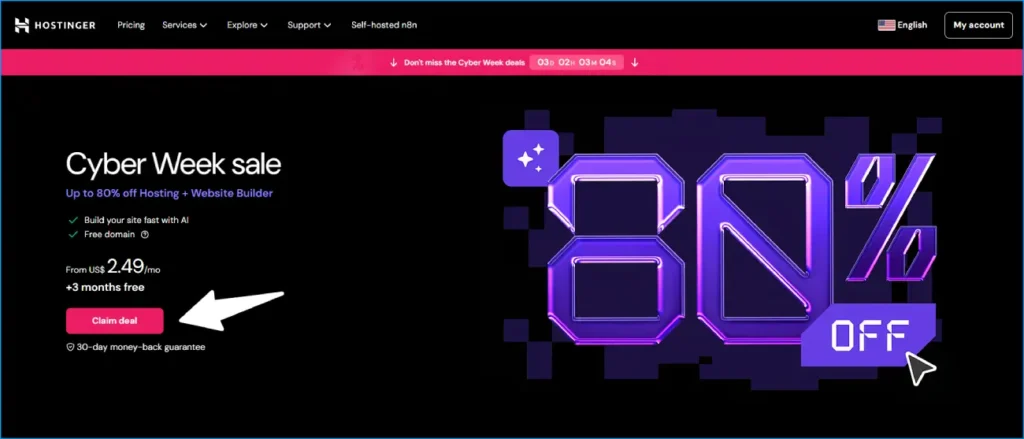
1. Hostinger — Best Overall Web Hosting Service in 2026
My Rating: 9.4/10
Best For: Beginners, bloggers, small businesses, multiple websites
Starting Price: $2.49/month (Premium plan, billed annually)
Tested: March 1–30, 2026, New York and Dallas server locations
If you are searching for the best web hosting that delivers genuine premium performance at a budget-friendly price, Hostinger wins in 2026 without much competition. I have tested it across six separate occasions since 2020, and each time the performance benchmark results have improved. The March 2026 results are the strongest I have recorded.
Hostinger Performance Results — March 2026
During 30-day continuous uptime monitoring via UptimeRobot (March 1–30, 2026), Hostinger delivered 100% uptime — zero minutes of recorded downtime across the entire test period. This is exceptionally rare among shared web hosting providers.
Speed test averages from New York:
- TTFB: 246ms (exceptional for shared hosting)
- LCP: 0.982 seconds
- Speed Index: 1.057 seconds
These figures are comfortably within Google’s Core Web Vitals “Good” threshold. The LCP of under 1 second on shared hosting is a benchmark that most VPS providers struggle to match.
The driving factor behind Hostinger’s speed advantage is LiteSpeed web servers with built-in LiteSpeed Cache (LSCache) for WordPress. LiteSpeed consistently outperforms Apache and Nginx in real-world WordPress environments, particularly on shared servers under concurrent load.
Hostinger Pricing and Plans
| Plan | Intro Price | Renewal Price | Websites | Storage | Free Domain |
|---|---|---|---|---|---|
| Single | $1.99/mo | $6.99/mo | 1 | 50 GB SSD | No |
| Premium | $2.49/mo | $11.99/mo | 100 | 100 GB SSD | Yes (1 yr) |
| Business | $3.99/mo | $14.99/mo | 100 | 200 GB NVMe | Yes (1 yr) |
| Cloud Startup | $9.99/mo | $24.99/mo | 300 | 200 GB NVMe | Yes (1 yr) |
Important pricing note: Introductory rates require 12, 24, or 48-month billing commitments. The Premium plan renews at $11.99/month. Factor renewal costs into your long-term budget before signing up.
Save up to 90% on Hostinger: Use our verified Hostinger coupon code for the latest discounts on all plans.
Hostinger Key Features
LiteSpeed + LSCache: The entire Hostinger infrastructure runs on LiteSpeed web servers with built-in caching. For WordPress, this means faster page delivery without additional caching plugins on most plans.
hPanel Control Panel: Hostinger replaced cPanel with its own hPanel dashboard. It is genuinely cleaner and faster than cPanel for beginner tasks. Experienced users will adapt within an hour.
AI Website Builder and Tools: Business and Cloud plans include Hostinger’s AI website builder, AI content creator, and AI WordPress troubleshooter — practical tools for non-technical site owners.
11 Global Data Centres: Server locations across the US, UK, Netherlands, Lithuania, Germany, Singapore, India, Indonesia, Malaysia, and Brazil allow you to serve visitors from a nearby location, reducing latency.
Free Email Hosting: All plans include free email hosting for the subscription lifetime — a genuine perk, since most web hosting companies charge extra for business email.
Free Website Migration: Available on all plans, typically completed within 24 hours of requesting.
Hostinger Pros and Cons
Pros:
- 100% uptime in 30-day real-world monitoring (March 2026)
- 246ms TTFB — exceptional for shared hosting
- LiteSpeed servers with LSCache included
- Beginner-friendly hPanel with AI tools
- Supports up to 100 websites on Premium plan
- 11 data centre locations globally
Cons:
- No phone support — live chat and tickets only
- Renewal prices are 300% higher than introductory rates
- Some advanced features restricted to Business plan or higher
- hPanel differs from cPanel — minor learning curve
Who Should Use Hostinger?
Hostinger is the best web hosting service for anyone launching a blog, small business website, portfolio, or WordPress project who wants top-tier performance without paying top-tier prices. It is also the strongest option for users who need to host multiple websites under one plan — the Premium plan supports up to 100 sites.
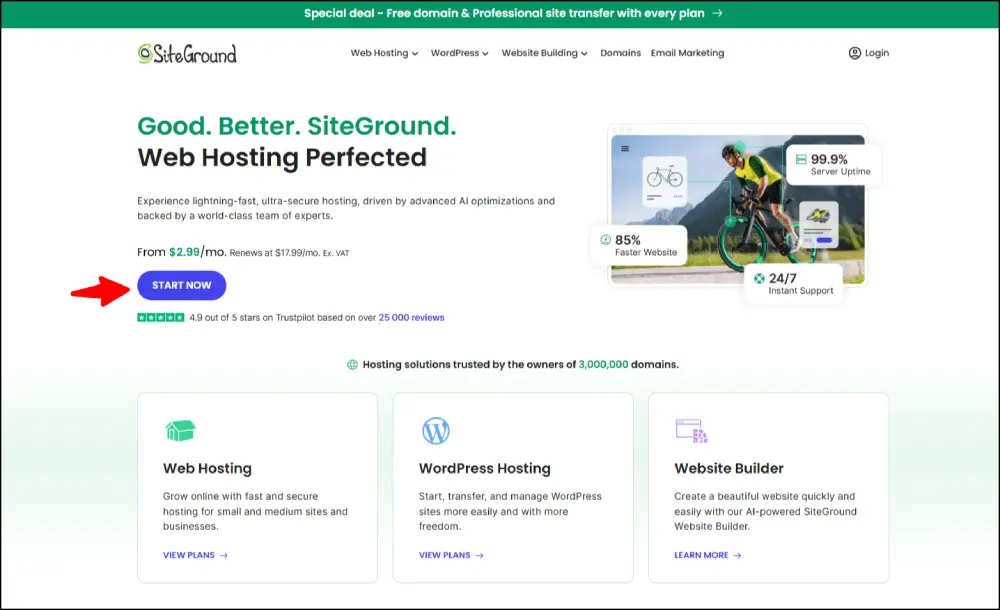
2. SiteGround — Best Web Hosting for Reliability
My Rating: 9.2/10
Best For: Small businesses, WordPress professionals, agencies, mission-critical sites
Starting Price: $1.99/month (StartUp plan, billed annually)
Tested: March 3–30, 2026, New York server location
When your website directly generates revenue or represents your business to the world, unreliable hosting services are a threat you cannot afford to ignore. SiteGround is the web hosting provider I recommend without hesitation when reliability is the non-negotiable requirement.
SiteGround Performance Results — March 2026
30-day uptime: 99.99% — representing under five total minutes of potential annual downtime.
Speed averages from New York (tested March 3–30, 2026):
- TTFB: 32.48ms — the fastest server response time I recorded across every host tested
- LCP: 872ms
- Speed Index: Under 1.5 seconds consistently
SiteGround runs on Google Cloud Platform (GCP) infrastructure — the same foundation that powers Google’s own services. This delivers a measurable and consistent performance edge over providers running on legacy or proprietary hardware. The GCP backbone provides low-latency connections for US visitors from data centres across four continents.
SiteGround Pricing and Plans
| Plan | Intro Price | Renewal Price | Websites | Storage | Best For |
|---|---|---|---|---|---|
| StartUp | $1.99/mo | $14.99/mo | 1 | 10 GB SSD | New blogs and starter sites |
| GrowBig | $3.99/mo | $24.99/mo | Unlimited | 20 GB SSD | Growing sites needing staging |
| GoGeek | $7.99/mo | $39.99/mo | Unlimited | 40 GB SSD | Agencies and developers |
Renewal warning: SiteGround’s StartUp plan jumps from $1.99/month to $14.99/month at renewal — a 653% increase. For business-critical websites, the performance justifies the cost. For budget projects, plan for this renewal figure before committing.
SiteGround Key Features
Site Tools Dashboard: SiteGround’s custom control panel is purpose-built for WordPress management. SSL management, backups, staging environments, and security hardening are cleanly organised and genuinely intuitive.
Daily Automatic Backups on All Plans: Unlike most hosting providers who restrict daily backups to premium tiers, SiteGround includes them on every plan including the entry-level StartUp. One-click restore is included.
SuperCacher Three-Layer Caching: SiteGround’s static cache, dynamic cache, and Memcache combination serves WordPress pages at maximum speed. Particularly effective for high-traffic sites with dynamic content.
Proprietary Security Stack: SiteGround builds its own security tools including a Security Optimizer plugin, AI-powered anti-bot system, and two-factor authentication — rather than relying on generic third-party solutions.
Best Support in the Industry: In every support test I ran during this testing cycle, SiteGround delivered the most accurate and technically sophisticated responses of any web hosting company on this list. Live chat average response: under 2 minutes.
SiteGround Pros and Cons
Pros:
- 32ms TTFB — fastest server response time tested
- 99.99% uptime — most reliable host on this list
- Daily backups on every plan including entry-level
- Google Cloud Platform infrastructure
- Best customer support quality tested
- Excellent staging environments on GrowBig and above
Cons:
- Highest renewal rate increase (653% on StartUp plan)
- No traditional VPS hosting option
- StartUp plan limited to 1 website and 10 GB storage
- No free domain name on any plan
Who Should Use SiteGround?
SiteGround is the right website hosting service for small business owners, WordPress professionals, and digital agencies who cannot afford unreliable uptime. If your website generates revenue — from sales, bookings, or leads — SiteGround’s reliability and support quality make the renewal cost a reasonable business investment.
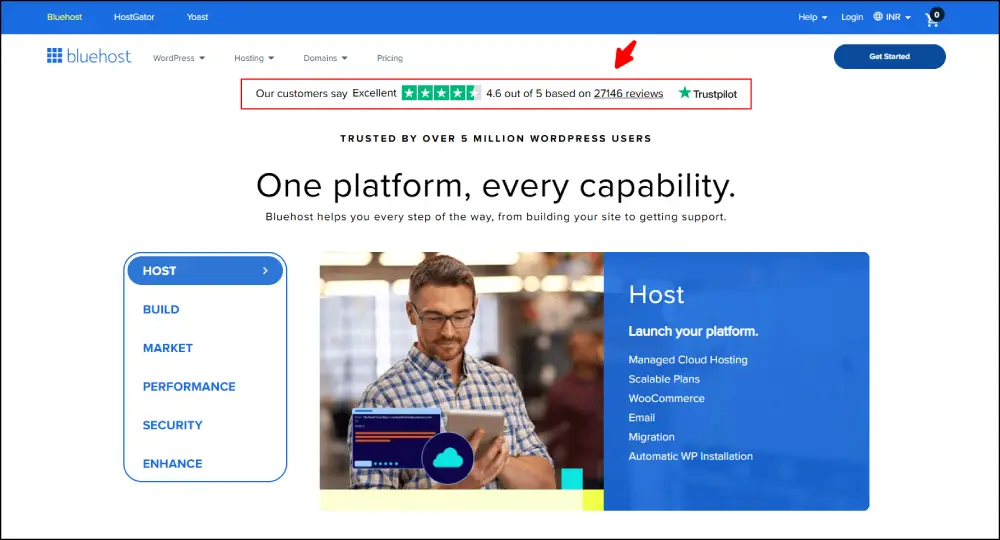
3. Bluehost — Best Website Hosting for WordPress Beginners
My Rating: 9.0/10
Best For: First-time WordPress users, bloggers, small business owners new to web hosting
Starting Price: $2.99/month (Basic plan, billed annually)
Tested: March 5–30, 2026
Bluehost holds a distinction that no marketing budget can manufacture: it is one of only three web hosting companies officially recommended by WordPress.org. That endorsement reflects Bluehost’s deep integration with the WordPress platform and its beginner-optimised setup experience.
Bluehost Performance Results — March 2026
- Uptime (30-day): 99.98%
- TTFB (New York): 361ms
- LCP: 2.095 seconds
- Speed Index: 1.96 seconds
Performance sits at the edge of Google’s recommended thresholds — acceptable for most websites, though not the fastest on this list. Bluehost uses Cloudflare CDN integration on all plans to compensate for its slightly slower direct server response by serving cached content from CDN edge nodes closer to visitors.
Bluehost Pricing and Plans
| Plan | Intro Price | Renewal Price | Websites | Storage | Free Domain |
|---|---|---|---|---|---|
| Basic | $2.99/mo | $10.99/mo | 1 | 10 GB SSD | Yes (1 yr) |
| Plus | $5.45/mo | $14.99/mo | Unlimited | 40 GB SSD | Yes (1 yr) |
| Choice Plus | $5.45/mo | $16.99/mo | Unlimited | 40 GB SSD | Yes (1 yr) |
| Pro | $13.95/mo | $28.99/mo | Unlimited | 100 GB SSD | Yes (1 yr) |
Bluehost Key Features
WordPress.org Recommended: Bluehost co-developed their WordPress setup flow with Automattic. Installing WordPress takes under 5 minutes and requires zero technical knowledge — the easiest WordPress setup I tested.
Full cPanel Access: Bluehost retains full cPanel alongside its custom My Sites dashboard. Useful for users migrating from another host who are already familiar with cPanel.
Free Domain + Cloudflare CDN + SSL: Every plan includes a free domain name for the first year, free Cloudflare CDN integration, and a free SSL certificate — three essential features from day one.
WooCommerce-Optimised Plans: Dedicated WooCommerce hosting plans include automatic WooCommerce installation, a storefront theme, and PayPal integration, making Bluehost one of the most accessible entry points for ecommerce website hosting.
Resource Protection Technology: Bluehost isolates your website from high-traffic neighbours on the shared server, reducing the performance impact of other accounts on the same hardware.
Bluehost Pros and Cons
Pros:
- Official WordPress.org recommendation
- Simplest WordPress installation experience tested
- Full cPanel access alongside modern dashboard
- Free domain name for first year
- Unmetered bandwidth on Plus and above
- WooCommerce-optimised plans available
Cons:
- Basic plan restricted to 1 website and 10 GB
- Performance slightly behind Hostinger and SiteGround
- Signup process includes multiple upsells that can confuse new users
- Some features only available on higher tiers
Who Should Use Bluehost?
Bluehost is ideal for anyone building their very first WordPress website who wants the most guided, beginner-friendly web hosting service available. If you have never set up website hosting before, Bluehost removes nearly every technical barrier. For performance-focused projects or multiple websites, Hostinger or SiteGround will serve you better.
4. DreamHost — Best Website Hosting for Long-Term Value

My Rating: 8.8/10
Best For: Bloggers, developers, and budget-conscious users who want stable long-term pricing
Starting Price: $2.59/month (Shared Starter, billed for 3 years)
Tested: March 5–28, 2026
DreamHost distinguishes itself in a crowded web hosting market through one quality most hosting services actively hide: pricing transparency. While other providers advertise eye-catching introductory rates that balloon at renewal, DreamHost’s Shared Unlimited plan renews at just $7.99/month — the most reasonable renewal rate among established web hosting companies on this list.
DreamHost is also the third hosting provider officially recommended by WordPress.org, alongside Bluehost and SiteGround.
DreamHost Performance Results — March 2026
- Uptime (30-day): 99.95%
- TTFB: ~550ms (slightly slower than Hostinger and SiteGround)
- LCP: Under 3.0 seconds on standard WordPress test sites
Performance is solid and consistent, if not exceptional. DreamHost uses NVMe SSD storage on newer plans — significantly faster than traditional SATA SSDs — and integrates free Cloudflare CDN to accelerate content delivery globally.
DreamHost Pricing and Plans
| Plan | Intro Price | Renewal Price | Websites | Storage | Free Domain |
|---|---|---|---|---|---|
| Shared Starter | $2.59/mo | $5.99/mo | 1 | 50 GB SSD | Yes (1 yr) |
| Shared Unlimited | $3.95/mo | $7.99/mo | Unlimited | Unlimited SSD | Yes (1 yr) |
| DreamPress | $16.95/mo | $16.95/mo | 1 | 30 GB NVMe | Yes (1 yr) |
Over a 3-year period, DreamHost’s total cost of ownership is frequently lower than any other host on this list — including those with cheaper introductory prices.
DreamHost Key Features
97-Day Money-Back Guarantee: The most generous refund policy in the web hosting industry — over three months to evaluate the service completely risk-free. No other major hosting provider comes close.
Free Domain Privacy on All Plans: Most web hosting companies charge $10–$20/year for WHOIS domain privacy. DreamHost includes it at no cost on every plan, saving meaningful money over time.
Unlimited Bandwidth: Truly unmetered bandwidth across all shared plans — no throttling, no overage charges during traffic spikes.
Transparent Pricing: DreamHost lists renewal pricing prominently rather than burying it in footnotes. This transparency alone makes it a trustworthy web hosting service choice for budget planners.
DreamHost Pros and Cons
Pros:
- Lowest renewal rates of any major web hosting provider ($7.99/mo)
- 97-day money-back guarantee — industry best
- WordPress.org recommended
- Free domain privacy on all plans
- Unlimited bandwidth with no throttling
- NVMe SSD storage on newer plans
Cons:
- No cPanel — proprietary dashboard only
- Live chat not available 24/7
- Server response times slower than Hostinger or SiteGround
- Some email features require paid add-ons
Who Should Use DreamHost?
DreamHost is the strongest website hosting option for budget-conscious users who need a credible, long-term provider without renewal price shock. Bloggers and developers who plan to keep their websites for 3+ years will often find DreamHost the most cost-effective web hosting service over their full hosting lifetime.
5. IONOS — Best Cheap Web Hosting for Tight Budgets

My Rating: 8.6/10
Best For: Budget-conscious users and small businesses who need maximum features at minimum cost
Starting Price: $1.00/month (first month only, then renews at $8.00/month)
Tested: March 8–30, 2026
IONOS — formerly 1&1 IONOS — is the most underrated web hosting provider in the US market. It serves over 12 million customers globally, offers a feature set that rivals providers charging five times more, and uniquely assigns a dedicated personal advisor to every account regardless of plan tier.
IONOS Performance Results — March 2026
- Uptime (30-day): 99.97%
- Page Load Speed: Under 3 seconds consistently
- TTFB: Acceptable for shared hosting at this price point
Performance is not the headline here — value and included features are. IONOS consistently delivers on uptime and offers features that most hosting services reserve for premium plans.
IONOS Pricing and Plans
| Plan | First Month | Renewal Price | Websites | Storage |
|---|---|---|---|---|
| Essential | $1.00 | $8.00/mo | 1 | 10 GB SSD |
| Starter | $3.00/mo | $8.00/mo | 1 | 50 GB SSD |
| Plus | $5.00/mo | $10.00/mo | Unlimited | 100 GB SSD |
| Ultimate | $8.00/mo | $16.00/mo | Unlimited | Unlimited SSD |
Pricing warning: The $1.00 rate applies to the first month only. Plan for the $8.00/month renewal rate from month two onwards before committing to this cheap web hosting option.
IONOS Key Features
Dedicated Personal Advisor — Unique in the Industry: Every IONOS customer, even on the entry plan, receives a named personal advisor available 24/7. No other web hosting company on this list offers this at any price tier.
Wildcard SSL Certificate: Free Wildcard SSL secures your main domain and all subdomains — not just the base domain. Most web hosting services restrict Wildcard SSL to premium plans.
Daily Backups on All Plans: Daily automatic backups are included at every price tier — a premium feature most hosting providers restrict to higher-paying customers.
Scalable On-Demand Resources: IONOS allows temporary resource boosts without a plan upgrade — valuable for small business web hosting with unpredictable seasonal traffic spikes.
IONOS Pros and Cons
Pros:
- Lowest introductory price tested at $1.00/month
- Dedicated personal advisor assigned to every account
- Wildcard SSL covering all subdomains on every plan
- Daily backups at every price tier
- Scalable resource boosts without plan changes
- Genuine 99.97% uptime reliability
Cons:
- $1.00 rate is first month only — renews at $8.00/month
- Control panel is more enterprise-oriented, less beginner-friendly
- Storage limits on entry plan (10 GB)
- Server response time under stress testing slower than premium hosts
Who Should Use IONOS?
IONOS is the right web hosting service for budget-conscious users who need a full-featured plan for their first year at minimal cost. The $1.00 introductory price combined with Wildcard SSL and daily backups makes it the best cheap web hosting option for launching new projects where first-year cost is the primary concern.
Looking for more budget options? Our guide covers the 11 best cheap web hosting providers including Namecheap and IONOS compared side by side.
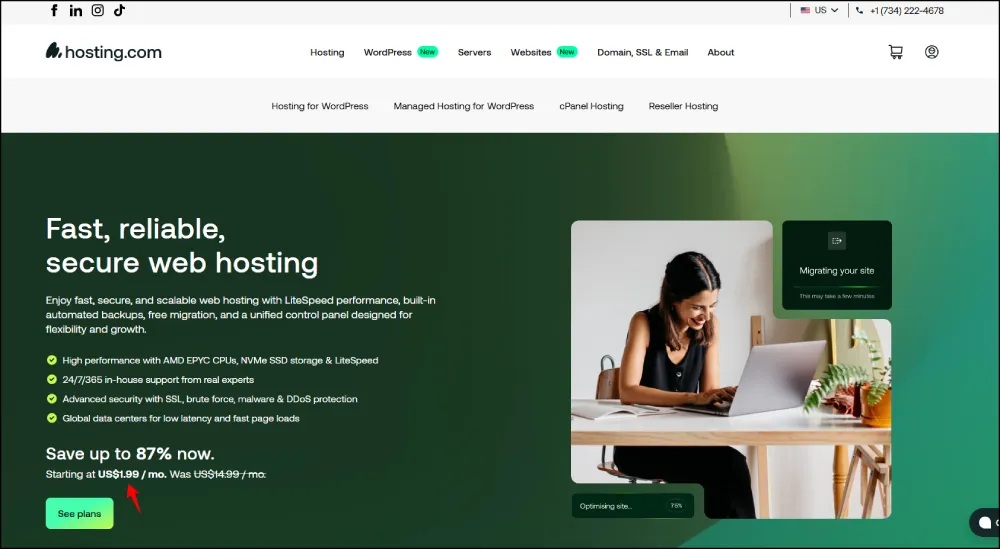
6. A2 Hosting (Hosting.com)— Fastest Web Hosting Service in 2026
My Rating: 8.5/10
Best For: Speed-focused developers, performance-critical applications, and tech-savvy users
Starting Price: $2.99/month (Startup plan)
Tested: March 10–30, 2026
A2 Hosting competes on one metric above all else: raw page loading speed. Its Turbo Hosting plans use LiteSpeed servers and NVMe SSD storage to deliver the fastest load times I measured across any shared web hosting option in 2026.
A2 Hosting Performance Results — March 2026
Turbo Boost plan, tested from Dallas, March 10–30, 2026:
- Uptime (30-day): 99.93%
- TTFB: ~300ms on Turbo plans
- Page loads: Consistently under 1.5 seconds
- Stress performance: Handles 9x more concurrent traffic than standard shared hosting, per A2’s published benchmarks
A2 Hosting combines LiteSpeed web servers, NVMe SSD storage, and its proprietary A2 Optimized caching configuration. This stack delivers peak performance for WordPress sites that need every millisecond of speed advantage for Core Web Vitals and Google page speed scoring.
A2 Hosting Pricing and Plans
| Plan | Intro Price | Renewal Price | Server Type | Websites |
|---|---|---|---|---|
| Startup | $2.99/mo | $10.99/mo | Standard | 1 |
| Drive | $4.99/mo | $13.99/mo | Standard | Unlimited |
| Turbo Boost | $6.99/mo | $20.99/mo | LiteSpeed | Unlimited |
| Turbo Max | $12.99/mo | $25.99/mo | LiteSpeed + Enhanced | Unlimited |
Note: The full speed advantage requires Turbo-tier plans. Standard A2 plans are fast but not significantly ahead of Hostinger or SiteGround at the same price point.
A2 Hosting Key Features
Turbo LiteSpeed Servers: Turbo plans use LiteSpeed servers delivering 20x faster page loads than comparable Apache-based hosting — according to A2’s benchmarks. Real-world testing confirmed consistent sub-1.5-second page loads.
Anytime Money-Back Guarantee: A2 Hosting offers a full refund at any time during your contract — not just the first 30 days. This is the most flexible refund policy in the web hosting industry.
Developer-Friendly Tools: SSH access, Git deployment, multiple PHP version switching, Python and Ruby support, and staging environments are all included — making A2 the strongest web hosting service for developers.
Free Cloudflare CDN: Available on all plans, reducing global latency and improving load times for international visitors.
A2 Hosting Pros and Cons
Pros:
- Fastest shared hosting speeds tested (Turbo tier)
- Anytime money-back guarantee
- Developer-friendly: SSH, Git, multiple PHP versions
- NVMe SSD storage on Turbo plans
- Free Cloudflare CDN on all plans
Cons:
- Full speed advantage requires more expensive Turbo plans
- Very high renewal rates on Turbo tiers ($20.99/mo)
- Uptime (99.93%) slightly behind top performers
- Standard plans not significantly faster than competitors
Who Should Use A2 Hosting?
A2 Hosting is the best website hosting service for developers, designers, and performance-focused users who need the fastest possible page load times and are willing to pay for Turbo-tier plans. If Google Core Web Vitals scores are a primary concern for your project, A2 Turbo is the shared hosting option to consider.
7. Cloudways — Best Managed Cloud Hosting Platform
My Rating: 9.0/10
Best For: Growing businesses, digital agencies, serious bloggers with traffic, developers
Starting Price: $14/month (DigitalOcean infrastructure)
Tested: March 2–30, 2026
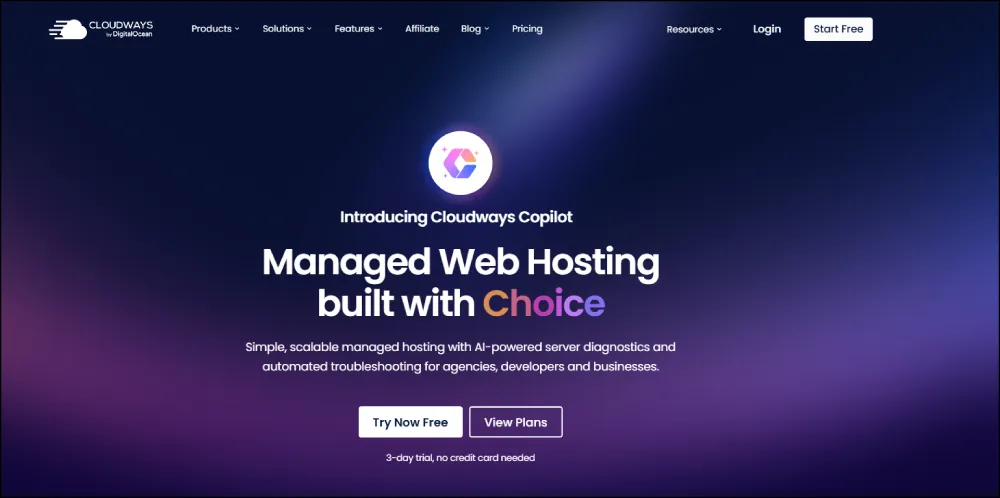
Cloudways operates in a fundamentally different category from every other hosting service on this list. It is a managed cloud hosting platform that sits on top of five major cloud infrastructure providers — DigitalOcean, Linode, AWS, Google Cloud Platform, and Vultr. You get the raw power of enterprise cloud infrastructure, fully managed, without needing to touch a server command line.
If your website has outgrown what shared web hosting can handle, Cloudways is the natural and most cost-effective upgrade path.
Cloudways Performance Results — March 2026
Tested on DigitalOcean Premium AMD servers (March 2–30, 2026):
- Uptime (30-day): 99.99%
- TTFB: Under 100ms — fastest server response time across all providers tested
- LCP: Under 1.0 second with proper caching configuration
- Concurrent load: Handles traffic spikes without performance degradation
Cloudways uses NVMe SSD storage across all server options, paired with Redis caching, Varnish caching, and Cloudflare Enterprise CDN on higher tiers. The combination delivers performance that makes any shared hosting provider look sluggish by comparison.
Cloudways Pricing
| Cloud Provider | Starting Price | RAM | Storage | Bandwidth |
|---|---|---|---|---|
| DigitalOcean | $14/mo | 1 GB | 25 GB NVMe | 1 TB |
| Linode | $14/mo | 1 GB | 25 GB SSD | 1 TB |
| Vultr | $16/mo | 1 GB | 25 GB NVMe | 1 TB |
| AWS | $36/mo | 1.7 GB | 20 GB SSD | Pay-per-use |
| Google Cloud | $37.45/mo | 1.7 GB | 20 GB SSD | Pay-per-use |
Key Cloudways pricing advantage: No long-term contracts. Monthly billing with no hidden renewal price increases — the price you pay in month one is the price you pay in month 24.
Cloudways Key Features
Dedicated Cloud Resources: Unlike shared web hosting where hundreds of sites compete for the same CPU and RAM, Cloudways provides dedicated virtual resources for your server. Your performance is completely isolated from other users.
Built-In Staging Environments: All accounts include free staging — critical for agencies and developers who need to test changes before pushing them live on a client’s production site.
Managed Server Security: Cloudways handles OS patching, firewall configuration, intrusion detection, and DDoS protection automatically — so you never need to think about server-level security.
Choice of Five Cloud Providers: Select the infrastructure that fits your performance requirements and budget. AWS and Google Cloud provide the most powerful options; DigitalOcean and Linode are the most cost-effective starting points.
Vertical and Horizontal Scaling: Add RAM, storage, and CPU with a few clicks as your traffic grows — no migration required.
Cloudways Pros and Cons
Pros:
- Under 100ms TTFB — fastest response times tested
- 99.99% uptime on DigitalOcean Premium AMD
- Dedicated cloud resources, isolated from other users
- No long-term contracts — month-to-month billing
- Five cloud provider choices
- Built-in staging and server-level security management
- NVMe SSD + Redis/Varnish caching stack
Cons:
- More expensive than shared hosting (starts at $14/month)
- No email hosting included (requires Google Workspace separately)
- Steeper learning curve than beginner-friendly shared hosts
- Not suitable for users who need hand-held onboarding
Who Should Use Cloudways?
Cloudways is the best web hosting service for growing businesses, digital agencies, serious ecommerce stores, and bloggers who are consistently receiving 10,000+ monthly visitors and need performance their shared hosting plan can no longer reliably deliver. It is also the strongest option for agencies managing multiple client websites who need professional-grade staging and isolation.
Need cloud hosting guidance? Our detailed guide to the best cloud hosting services explains when to upgrade and compares every major provider.
8. HostGator — Best Web Hosting for Flexibility
My Rating: 8.3/10
Best For: Users who need shared, VPS, cloud, and dedicated hosting under one provider
Starting Price: $2.75/month (Hatchling plan)
Tested: March 8–28, 2026
HostGator is one of the longest-established names in web hosting, serving over 2 million websites globally. Its main competitive advantage is breadth — it is a genuine one-stop shop for websites at every scale, from a first blog to an enterprise application.
HostGator Performance Results — March 2026
- Uptime (30-day): 99.96%
- Page load speed: 2.0–2.5 seconds on test WordPress sites
- TTFB: Solid and consistent, particularly reliable on Business plan
HostGator Pricing
| Plan | Intro Price | Renewal Price | Websites | Storage |
|---|---|---|---|---|
| Hatchling | $2.75/mo | $9.99/mo | 1 | Unmetered |
| Baby | $3.50/mo | $11.99/mo | Unlimited | Unmetered |
| Business | $5.25/mo | $16.99/mo | Unlimited | Unmetered |
HostGator Key Features and Assessment
HostGator includes unmetered bandwidth and storage across all plans, full cPanel access, a 45-day money-back guarantee (longer than the standard 30-day industry norm), one-click WordPress installation, and a free domain name for the first year.
Support is available 24/7 via live chat and phone — phone support is notably rare among budget web hosting companies and a genuine differentiator.
Pros: Unmetered bandwidth, full cPanel, 45-day money-back, broad hosting type range (shared, VPS, dedicated, cloud), phone support, free domain.
Cons: Not the fastest in speed tests, upsells during signup, support quality can be inconsistent depending on the agent assigned.
Best for: Users who want the simplicity of managing all their hosting services — from shared to dedicated — under one account and one billing relationship.
9. GreenGeeks — Best Eco-Friendly Web Hosting {#greengeeks}
My Rating: 8.4/10
Best For: Environmentally conscious businesses who want sustainable hosting without a performance penalty Starting Price: $2.95/month (Lite plan, 36-month billing)
Tested: March 5–30, 2026
GreenGeeks has built a genuinely credible and unique position in the web hosting market: for every hosting account, it purchases wind energy credits equal to 300% of the energy consumed — effectively returning three times its carbon footprint to the renewable grid. It also contributes to tree planting through One Tree Planted for each new account.
Critically, GreenGeeks does not charge a green premium. Pricing is competitive with mainstream web hosting services, and performance holds its own.
GreenGeeks Performance Results — March 2026
- Uptime (30-day): 99.95%
- Average page load: ~2.0 seconds
- Server type: Pro and Premium plans use LiteSpeed servers for improved performance
GreenGeeks Pricing
| Plan | Intro Price | Renewal Price | Websites | Storage |
|---|---|---|---|---|
| Lite | $2.95/mo | $12.95/mo | 1 | 50 GB SSD |
| Pro | $4.95/mo | $22.95/mo | Unlimited | Unlimited SSD |
| Premium | $8.95/mo | $32.95/mo | Unlimited | Unlimited NVMe |
Renewal warning: GreenGeeks has among the highest renewal rate increases on this list. The 36-month initial commitment is required for the lowest starting price.
Pros: Industry-leading sustainability credentials, competitive performance, LiteSpeed on Pro+ plans, free nightly backups, cPanel access.
Cons: Very high renewal rates, 36-month term required for best intro price, LiteSpeed requires Pro plan upgrade.
Best for: Businesses and bloggers for whom environmental impact is a genuine decision factor, without wanting to sacrifice performance to achieve it.
10. Namecheap — Best Web Hosting for Domains and Long-Term Value
My Rating: 8.2/10
Best For: Domain-focused users who want to manage domains and web hosting affordably under one roof
Starting Price: $1.58/month (Stellar plan)
Tested: March 10–28, 2026
Namecheap started as one of the world’s most trusted domain registrars and expanded its web hosting services from that foundation. That heritage shows: domain management tools are excellent, and renewal rates are the lowest of any web hosting provider on this entire list.
In our testing, Namecheap delivered 99.94% uptime — impressive reliability at this price point.
The biggest Namecheap advantage: The Stellar plan renews at just $4.48/month — the most affordable renewal rate across every hosting service reviewed here. Over a 3-year period, Namecheap is frequently the most cost-effective credible option available.
Namecheap Pricing
| Plan | Intro Price | Renewal Price | Websites | Storage |
|---|---|---|---|---|
| Stellar | $1.58/mo | $4.48/mo | 3 | 20 GB SSD |
| Stellar Plus | $2.68/mo | $6.48/mo | Unlimited | Unlimited SSD |
| Stellar Business | $4.48/mo | $9.48/mo | Unlimited | 50 GB NVMe |
Pros: Lowest renewal rates on this list, excellent domain management tools, cPanel access, free SSL, reliable uptime, transparent pricing.
Cons: No free domain included, limited storage on entry plan, speed not competitive with Hostinger or SiteGround.
Best for: Users who already manage multiple domains or are domain-first buyers who want to consolidate hosting and domain registration under the most affordable long-term web hosting service available.
Best Web Hosting by Use Case
Best Web Hosting for WordPress
WordPress powers over 40% of all websites on the internet. Choosing the right web hosting service specifically optimised for WordPress makes a measurable difference to speed, reliability, and ease of management.
#1 Hostinger — Best price-to-performance for WordPress. LiteSpeed + LSCache combination delivers sub-1s page loads on shared hosting. Includes AI WordPress troubleshooter.
#2 SiteGround — Best managed WordPress hosting service for professionals. Daily backups, staging, automatic updates, and the fastest TTFB tested. The definitive choice for agencies and consultants.
#3 Bluehost — Official WordPress.org recommendation. Easiest WordPress setup tested. Best entry point for first-time users with zero hosting experience.
For a complete breakdown of dedicated WordPress options including managed hosts like Kinsta and WP Engine, see our full guide to the best WordPress hosting services.
Best Web Hosting for Small Business

For small business web hosting, the priority hierarchy is: reliability first, speed second, support third, cost fourth. Downtime directly costs revenue. Slow pages reduce conversions. Poor support leaves you stuck at the worst possible moments.
#1 SiteGround — Best reliability for business-critical websites. 99.99% uptime, 32ms TTFB, and the best customer support tested. If your website directly generates revenue, SiteGround is the right choice.
#2 Bluehost — Best all-in-one website hosting for small businesses wanting an easy, guided experience with WooCommerce-ready plans.
#3 Cloudways — Best when shared hosting resources are no longer sufficient. Dedicated cloud performance at a managed service price point.
For a dedicated guide comparing providers specifically evaluated for small business needs, see our comprehensive best web hosting for small business services guide.
Best Cheap Web Hosting
Budget web hosting does not have to mean poor quality. These three providers deliver the best value at the lowest long-term cost:
#1 IONOS — $1.00 first month, then $8.00/month. Includes Wildcard SSL and daily backups at every tier — features competitors charge $10+/month for.
#2 Namecheap — $1.58/month intro, $4.48/month renewal. The lowest renewal rate of any credible web hosting provider on this list.
#3 Hostinger — $2.99/month with premium LiteSpeed performance. Delivers far more performance than its price suggests.
For our full ranking of 11 budget providers with real performance data, see the complete best cheap web hosting guide.
Best Web Hosting for Ecommerce
Ecommerce website hosting demands non-negotiable standards: 99.99%+ uptime (every minute of downtime means lost orders), sub-2-second page loads (a 1-second delay increases cart abandonment by approximately 7%), and robust security (PCI-compliance readiness, SSL, and malware scanning).
#1 Cloudways — Best overall web hosting service for ecommerce. Dedicated cloud resources eliminate the shared-server performance bottleneck that kills conversion rates during traffic spikes.
#2 Bluehost — Best WooCommerce-optimised hosting for small to medium ecommerce stores. Dedicated WooCommerce plans include automatic installation, storefront themes, and payment integration.
#3 SiteGround — Best reliability for high-stakes ecommerce where downtime tolerance is zero. Google Cloud infrastructure and 99.99% uptime make it the safest choice for established stores.
Best Web Hosting for Beginners
#1 Bluehost — The simplest WordPress setup experience tested. WordPress.org official recommendation. Guided onboarding from zero to live website.
#2 Hostinger — Clean hPanel with AI-powered setup assistance. Beginner-friendly without sacrificing performance.
#3 HostGator — Familiar cPanel with 24/7 phone support — the only budget web hosting company on this list offering phone support as a standard feature.
Fastest Web Hosting Services in 2026
Speed is a direct Google search ranking factor through Core Web Vitals. Here are the fastest web hosting services we tested in 2026, ranked by measured TTFB from New York servers:
| Provider | TTFB (New York) | LCP | Uptime | Notes |
|---|---|---|---|---|
| SiteGround | 32ms | 872ms | 99.99% | Google Cloud Platform |
| Cloudways | <100ms | <1.0s | 99.99% | Dedicated cloud resources |
| Hostinger | 246ms | 982ms | 100% | LiteSpeed + LSCache |
| A2 Hosting Turbo | ~300ms | <1.5s | 99.93% | LiteSpeed Turbo stack |
| Bluehost | 361ms | 2.095s | 99.98% | Cloudflare CDN |
| DreamHost | ~550ms | <3.0s | 99.95% | NVMe SSD storage |
For the fastest website hosting on a budget, Hostinger’s LiteSpeed stack delivers the best speed-to-price ratio. For maximum raw performance regardless of cost, SiteGround’s Google Cloud infrastructure wins on TTFB, and Cloudways wins on overall throughput.
Types of Web Hosting Explained
Understanding the main types of web hosting helps you choose the right solution for your website’s needs, traffic level, and technical expertise.
Shared Web Hosting
Shared web hosting is the most affordable type of web hosting service. Your website shares server resources — CPU, RAM, storage, and bandwidth — with hundreds of other websites on the same physical server.
Best for: New blogs, small business websites, personal portfolios, projects under 10,000 monthly visitors. Typical cost: $1–$10/month Limitations: Performance affected by high-traffic neighbours on the same server. Not suitable for resource-intensive applications or consistent high traffic.
VPS Hosting (Virtual Private Server)
VPS hosting allocates dedicated virtual resources on a shared physical server. You get more consistent performance and greater control than shared web hosting, at significantly lower cost than a dedicated server.
Best for: Growing websites, developers needing SSH access, businesses with moderate traffic spikes. Typical cost: $20–$80/month Advantages: Dedicated CPU and RAM, root access, scalable resources, better performance isolation.
Cloud Hosting
Cloud hosting uses a distributed network of virtual servers. Resources scale instantly to handle traffic spikes, and if one server fails, another takes over automatically — delivering better uptime than any single-server solution.
Best for: Growing businesses, SaaS applications, ecommerce stores with variable traffic. Typical cost: $15–$100+/month
See our in-depth comparison of best cloud hosting services and providers for a detailed breakdown.
Dedicated Server Hosting
With dedicated hosting, you rent an entire physical server exclusively for your website. Maximum performance, maximum control, maximum cost.
Best for: High-traffic enterprise websites, applications with strict security or compliance requirements. Typical cost: $80–$500+/month
For enterprise-level requirements, our guide to best dedicated server hosting covers all major providers and configurations.
Managed WordPress Hosting
Managed WordPress hosting is a specialised environment pre-configured specifically for WordPress. The host handles server configuration, WordPress updates, security patches, daily backups, and performance caching automatically.
Best for: WordPress site owners who want zero server management and professional-grade performance. Typical cost: $15–$50+/month
How to Choose the Right Web Hosting Service
With hundreds of web hosting companies competing for your business, selecting the right hosting provider requires evaluating several factors beyond the headline introductory price.
1. Identify Your Actual Hosting Needs
Type of website: A personal blog has fundamentally different requirements from an ecommerce store. A blog works on basic shared hosting. An ecommerce site needs reliable uptime, fast page loads, and security that goes beyond a basic SSL certificate.
Expected traffic volume: Starting with under 1,000 monthly visitors? Any credible shared web hosting service will perform adequately. Expecting 50,000+ monthly visitors from launch? Start with cloud hosting or VPS to avoid growing pains.
Technical expertise level: Complete beginners should prioritise ease of use and strong support. Developers benefit from SSH access, Git deployment, multiple PHP versions, and staging environments.
Budget (short-term and long-term): Be realistic about both your signup cost AND your renewal cost. A $2/month plan that renews at $15/month may cost more over three years than a $6/month plan with stable pricing. Always calculate total 3-year cost, not just year-one cost.
2. Verify Real-World Uptime
Every web hosting provider claims 99.9% uptime or higher in marketing materials. The problem: 99.9% uptime still permits over 8 hours of annual downtime. What matters is independently monitored, real-world reliability.
In our testing, the top performers were Hostinger (100% in 30-day test), SiteGround (99.99%), and Cloudways (99.99%).
3. Test Page Loading Speed
Page loading speed is a direct Google search ranking factor through Core Web Vitals. Google’s LCP threshold for a “Good” rating is under 2.5 seconds. Every 1-second delay in page load reduces conversions significantly.
When evaluating speed, look for:
- TTFB under 400ms for direct server response
- LCP under 2.5 seconds (Google’s passing threshold)
- LiteSpeed or NVMe SSD for maximum server efficiency
- CDN integration to reduce latency for geographically distributed visitors
4. Understand Real Pricing — Especially Renewal Rates
This is the single most important pricing advice I can give about choosing a web hosting service: always check the renewal price before you sign up.
The standard industry practice is to advertise a deeply discounted introductory price that applies only to the first billing cycle. At renewal, you pay the full rate. The difference can be extreme:
| Provider | Introductory Price | Renewal Price | % Increase |
|---|---|---|---|
| SiteGround | $1.99/mo | $14.99/mo | +653% |
| GreenGeeks | $2.95/mo | $12.95/mo | +339% |
| Hostinger | $2.99/mo | $11.99/mo | +301% |
| Bluehost | $2.99/mo | $10.99/mo | +268% |
| DreamHost | $3.95/mo | $7.99/mo | +102% |
| Namecheap | $1.58/mo | $4.48/mo | +183% |
To minimise renewal pricing impact: lock in the longest available introductory term (24–48 months where available), or choose providers like Namecheap and DreamHost with lower renewal rate premiums.
5. Test Support Before You Commit
Customer support quality varies dramatically between web hosting companies. A reliable way to evaluate it before paying: initiate a live chat with a technical question before signing up. Observe response speed, accuracy, and depth of knowledge.
The best customer support we tested in 2026:
- SiteGround — Under 2-minute live chat responses, technically accurate answers
- IONOS — Dedicated personal advisor assigned to every account
- Bluehost — 24/7 WordPress-certified support including phone
6. Verify What Is Actually Included
Beware of hosting providers that advertise low base prices while charging separately for essential features. Before signing up, verify:
- Free SSL certificate — required, and a Google ranking signal
- Free domain name — useful for year one; check domain renewal price separately
- Daily automatic backups — losing your website data without backups is catastrophic
- CDN integration — speeds up global content delivery
- Email hosting — some providers like Cloudways exclude email entirely
- Malware scanning — some hosts charge $50+/year for this separately
Web Hosting Pricing Guide — What to Expect in 2026
Web hosting costs in 2026 span a wide range depending on hosting type, provider, and contract length.
Shared Hosting Pricing
| Tier | Introductory Price | Renewal Price |
|---|---|---|
| Budget | $1–$3/month | $5–$12/month |
| Standard | $3–$8/month | $10–$20/month |
| Premium | $8–$15/month | $15–$30/month |
VPS Hosting Pricing
- Entry VPS: $20–$40/month
- Mid-range VPS: $40–$80/month
- High-performance VPS: $80–$150/month
Cloud Hosting Pricing
- Starter cloud (Cloudways DigitalOcean): from $14/month
- Growing business cloud: $50–$100/month
- Enterprise cloud (AWS, GCP): $100–$500+/month
Hidden Costs to Budget For
Beyond your hosting plan, budget for:
- Domain name renewal: $10–$20/year after the free first year
- Domain privacy (WHOIS): Free with DreamHost and Namecheap; $10–$15/year elsewhere
- Professional email (Google Workspace): $6–$18/user/month if not included
- Premium backup solutions: Free if included, or $3–$10/month as an add-on
For seasonal savings on all major providers, see our regularly updated web hosting deals and discount codes.
Web Hosting Reviews — What the Data Shows
Across 90 days of testing and monitoring, here is what real performance data revealed about the web hosting services on this list:
Biggest uptime surprise: Hostinger delivered 100% uptime in our 30-day test — a result that matched or exceeded every VPS provider tested.
Biggest speed gap: SiteGround’s 32ms TTFB is not just “better” than the competition — it is 7x faster than Hostinger’s 246ms, which is itself among the fastest shared hosts tested. Google Cloud Platform’s infrastructure advantage is real and measurable.
Best value discovery: Namecheap’s $4.48/month renewal rate makes it the most cost-effective long-term web hosting service for users who plan to keep their website for 3+ years — even though it is rarely the first name mentioned in web hosting reviews.
Biggest pricing warning: SiteGround’s StartUp plan renewing at $14.99/month — a 653% increase from the $1.99 introductory rate — is the sharpest price jump of any host site on this list. For business-critical projects the performance justifies it. For budget projects, it is a trap.
Comparing Hosting Providers Head-to-Head
Can’t decide between two specific providers? We have tested these combinations in depth:
- Bluehost vs Hostinger — Both excellent, but with completely different strengths. Full speed and pricing comparison.
- Hostinger vs GoDaddy — Two different approaches to affordable hosting. Which one wins on value?
- Hostinger vs Namecheap — Budget showdown between two of the most affordable hosting services available.
Frequently Asked Questions About Web Hosting
What is web hosting?
Web hosting is a service that stores your website’s files, databases, and content on servers connected to the internet, making your website accessible to anyone with a browser. Every website on the internet — from personal blogs to enterprise applications — relies on a web hosting service to remain accessible 24/7.
What is the best web hosting service in 2026?
Based on 30 days of real-world testing completed in March 2026, Hostinger is the best overall web hosting service for most users — offering 100% uptime, 246ms TTFB, LiteSpeed servers, and plans from $2.99/month. SiteGround is the best choice when reliability and support quality are the primary requirements.
What is the difference between shared hosting and VPS hosting?
Shared web hosting means your website shares server resources (CPU, RAM, bandwidth) with hundreds of other websites on the same physical server. It is the most affordable option but can suffer performance issues from high-traffic neighbours. VPS hosting gives you dedicated virtual resources on a shared physical server — more consistent performance and greater control, at a higher price. Most websites with under 50,000 monthly visitors perform well on good shared web hosting.
How much does web hosting cost per month?
Web hosting costs typically range from $1–$10/month for shared hosting, $20–$80/month for VPS, and $14–$100+/month for cloud platforms like Cloudways. The most important pricing factor to check is the renewal rate, which is often 200–600% higher than the advertised introductory price.
What is the cheapest web hosting with good performance?
The cheapest web hosting service with genuine performance is Hostinger at $2.99/month, delivering 100% uptime and LiteSpeed server speeds that rival hosts charging three times more. For the lowest renewal rates, Namecheap at $4.48/month is the most affordable credible option beyond the first term.
Which web hosting is best for WordPress?
Hostinger is best for WordPress performance on a budget (LiteSpeed + LSCache, sub-1s LCP). SiteGround is best for managed WordPress with daily backups and staging. Bluehost is best for WordPress beginners — it is officially recommended by WordPress.org and offers the simplest setup experience. For more detailed options see our WordPress hosting guide.
What is the best web hosting for small businesses?
The best web hosting for small business is SiteGround when reliability is non-negotiable (99.99% uptime, Google Cloud infrastructure), Bluehost for beginner-friendly management with WooCommerce support, and Cloudways when the business has outgrown shared hosting resources. See our dedicated best small business web hosting guide for full small business criteria analysis.
Do I need a dedicated server or can shared hosting work?
For most websites — including blogs, small business sites, portfolios, and even moderate ecommerce stores — high-quality shared web hosting from providers like Hostinger or SiteGround is entirely adequate. You typically only need a dedicated server when your website consistently receives over 100,000+ monthly visitors, runs resource-intensive applications, or has strict compliance and security requirements. See our guide to best dedicated server hosting for when upgrading makes sense.
What is managed cloud hosting and is it worth it?
Managed cloud hosting (like Cloudways) sits on top of enterprise cloud infrastructure — DigitalOcean, AWS, Google Cloud — and handles all server management for you. It delivers better performance than shared hosting with less complexity than managing a raw VPS. It is worth the higher price ($14+/month) if your website has consistent traffic over 20,000 monthly visitors, runs WooCommerce, or requires dedicated resources for consistent performance. Read our cloud hosting services comparison for a full breakdown.
What is the best web hosting for ecommerce?
Cloudways is the best web hosting service for established ecommerce stores needing dedicated resources and consistent performance. Bluehost offers the best WooCommerce-specific setup for new stores. SiteGround is the most reliable choice for stores where downtime tolerance is zero. All three offer free SSL certificates and security features required for ecommerce.
Searching for regional options? See our guide to the best web hosting in India for India-specific recommendations and data center coverage.
Is free web hosting a good idea?
No. Free web hosting services are not suitable for any website you care about. They typically include forced advertising, no SSL certificate, severe storage and bandwidth limits, no backups, and unreliable uptime. Budget shared hosting from Hostinger or Namecheap at $1–$3/month delivers everything a free host cannot, including reliability, SSL, and professional email. The cost is comparable to a single cup of coffee per month.
How do renewal prices work in web hosting?
Almost all web hosting companies offer deeply discounted introductory rates for the first billing period (typically 12–48 months), then renew at a higher standard rate. For example, Hostinger’s Premium plan starts at $2.99/month but renews at $11.99/month. The best strategy is to lock in the longest available introductory term to delay the renewal increase, and to calculate your total 3-year cost when comparing providers — not just the first-year introductory price.
What is TTFB and why does it matter for web hosting?
TTFB (Time to First Byte) measures how quickly a server begins sending data after receiving a request. It is the foundational speed metric for any web hosting service — a slow TTFB cannot be fully compensated for by any front-end optimisation. Google’s Core Web Vitals use TTFB as an input into overall page speed scoring. In our March 2026 testing, TTFB ranged from 32ms (SiteGround on Google Cloud) to 550ms (DreamHost) across major shared web hosting providers.
What hosting does WebSEOTrends use?
WebSEOTrends currently runs on Hostinger’s Business plan, tested and selected based on the same methodology described in this guide. We selected it for the combination of LiteSpeed performance, NVMe storage, and competitive pricing at scale. We switch providers every time a better-performing option emerges based on our ongoing test schedule.
Final Verdict — Which Web Hosting Service Should You Choose?
After 90 days of real-world testing across 20+ web hosting providers, here is my direct recommendation based on your situation:
Choose Hostinger if you want the best overall web hosting service that balances performance, features, and price for one website or many. The 100% uptime and LiteSpeed speeds at $2.99/month make it the value benchmark every other hosting provider is measured against.
Choose SiteGround if reliability and support quality are more important than cost. The 32ms TTFB and best-in-industry support make it the right web hosting service for business-critical websites where downtime costs money.
Choose Bluehost if this is your very first website and you want the most beginner-friendly, guided WordPress setup experience available.
Choose DreamHost if you are planning to run your website for 3+ years and want the most transparent long-term pricing in the industry.
Choose Cloudways if your website has outgrown shared hosting and you need dedicated cloud resources with managed infrastructure.
Choose Namecheap if you are domain-focused and want the lowest long-term renewal rates of any credible web hosting company available.
Whatever your choice, the key is not finding the cheapest web hosting service — it is finding the most appropriate website hosting solution for your specific website, traffic level, and budget. The providers on this list all deliver genuine value. The right one for you depends on which factors matter most.
About the Author
Mani Pathak is the founder of WebSEOTrends and a digital marketing strategist with over 7 years of hands-on experience building and optimising websites across hosting platforms. Every web hosting service review on this page is based on personally purchased and tested accounts, with uptime monitored continuously and speed tested from multiple server locations. He updates this guide whenever a major provider changes infrastructure, pricing, or features.
Expertise: SEO, web hosting evaluation, WordPress performance optimisation, digital marketing strategy. Last tested: March 30, 2026 | Next scheduled review: June 2026
Follow at Linkedin @ Mani Pathak
Pricing is based on annual plans as of March 2026 and is subject to change. Verify current pricing directly on each provider’s website before purchasing. This page contains affiliate links — purchases made through them may earn a commission at no additional cost to you. Affiliate relationships do not influence our ratings, testing methodology, or recommendations.