AI Influencer Generator: Best Tools to Create Realistic AI Influencers
Table of Contents
AI influencer generators are transforming how creators and brands build digital personalities for social media, ads, and content monetization. With the right AI influencer generator, you can create hyper-realistic AI influencers, produce engaging videos, and scale UGC content without hiring human creators.
In this guide, we compare the best AI influencer generators available today, including free AI influencer generator tools, video-based platforms, and Instagram-focused solutions. You’ll learn how to create your own AI influencer, what features matter most, and which tools offer the best value for monetization, affiliate marketing, and brand collaborations.
Whether you want to make an AI influencer for Instagram, build AI-generated influencer videos, or explore how AI influencers make money, this page breaks down everything you need to choose the right platform and start earning.
Top AI Influencer Generators Reviewed (In-Depth)
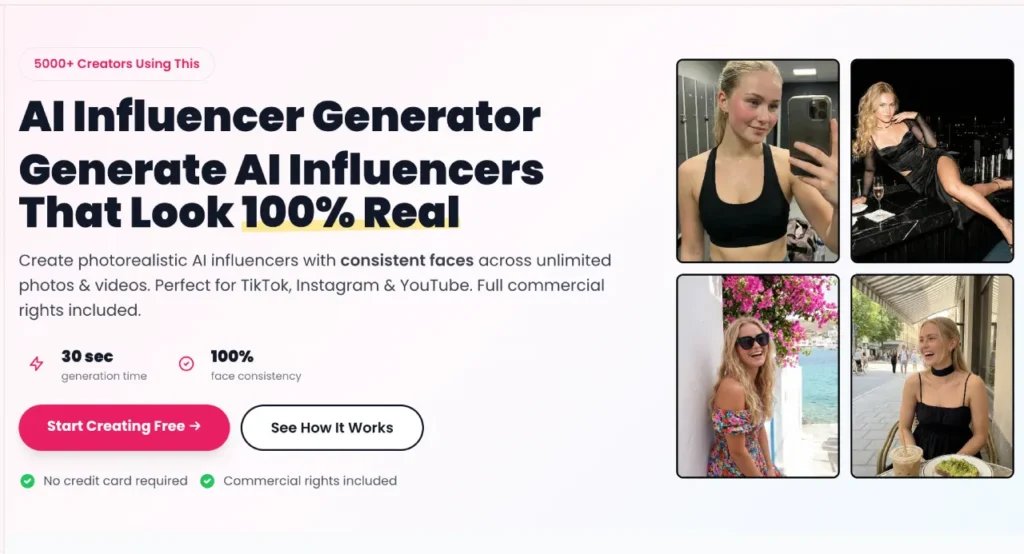
When I first started testing AI influencer generators, I quickly realized one thing: not all tools that claim to create AI influencers are actually built for real-world use. Some are just image generators. Others look impressive in demos but fall apart when you try to create consistent content or monetize it.
So instead of listing random tools, I personally focused on platforms that actually help you create, scale, and monetize AI influencers — whether your goal is Instagram growth, UGC ads, affiliate marketing, or brand deals.
Below, I’m sharing what worked, what didn’t, and which AI influencer generators are genuinely worth your time and money.
1. ZenCreator – Best Overall AI Influencer Generator
If you’re looking for the most complete AI influencer generator, ZenCreator is where I’d start.
What I like most about ZenCreator is that it doesn’t just generate a face and stop there. You can create consistent AI influencers, generate multiple images and videos, and reuse the same character across different posts and campaigns. That consistency is critical if you want your AI influencer to feel real and recognizable over time.
I also appreciate that ZenCreator offers a real free tier. You don’t need to enter a credit card just to test it, which makes it perfect if you’re still experimenting or validating an idea.
Why ZenCreator works so well
You can create both AI influencer images and videos
The same AI influencer can be reused across posts
Outputs are optimized for Instagram, TikTok, and YouTube
Beginner-friendly once you understand the workflow
Where it can improve
Advanced video features are locked behind paid plans
You’ll need some trial and error to get the best prompts
Who I recommend it for:
If you want a long-term AI influencer brand, not just a one-off image, ZenCreator is easily one of the best choices.
2. ReelMoney – Best for Fast AI Influencer Creation
When speed matters, ReelMoney really shines.
I found ReelMoney especially useful when I wanted to quickly test niches or create short-form influencer content without spending hours tweaking settings. You can go from idea to AI influencer content in minutes, which is great if you’re focused on Instagram Reels, TikTok, or YouTube Shorts.
The platform walks you through the process step by step, which makes it ideal if you’re new to AI influencers or don’t want to deal with complex controls.
What I liked
Very fast AI influencer creation
Simple interface with guided steps
Good balance between automation and customization
Free trial available to test before upgrading
Limitations
Less advanced customization compared to full creative suites
Best suited for short-form content rather than cinematic videos
Who should use it:
If you want to create AI influencers quickly and publish often, ReelMoney is a solid choice.
3. Best Free AI Influencer Generator Option (For Beginners)
A lot of people ask me if there’s a free AI influencer generator that actually works. From my testing, ZenCreator’s free tier is one of the few that genuinely lets you experiment without forcing payment upfront.
You won’t get unlimited usage, but you can still:
Test different influencer styles
Understand how AI influencer creation works
Validate your niche before investing money
That makes it perfect if you’re just starting or if you want to explore AI-generated influencers for Instagram without risk.
Best use case:
Learning, testing, and early-stage experimentation before scaling.
4. Quickads AI – Best for Creative Control & Campaign Content
If your focus is more on creative freedom and visual control, Quickads AI is worth looking at.
I found Quickads especially useful when designing influencer visuals for ads and branded content. You can control poses, styles, moods, and overall aesthetics much more precisely than with beginner-focused tools.
This makes it a strong option if you’re running UGC-style ad campaigns or want your AI influencer to match a specific brand look.
Strengths
High level of visual customization
Great for product-focused influencer content
Scales well for ad campaigns
Weaknesses
Less beginner-friendly
Focused more on visuals than full influencer workflows
Who it’s best for:
Marketers and creators who already know what kind of influencer they want to build.
5. AI Influencer Video Tools (Talking Avatars & Video Content)
Some platforms focus less on “Instagram influencer aesthetics” and more on AI influencer videos — especially talking avatars.
Tools like HeyGen and similar AI video platforms work well if your AI influencer needs to:
Speak on camera
Deliver scripted content
Create explainer or promotional videos
In my experience, these tools work best after you’ve already defined your AI influencer’s identity using a generator like ZenCreator or ReelMoney. Think of them as video extensions, not replacements.
Top AI Influencer Generators Compared – Features, Pricing & Best Use
Here’s a complete comparison of the best AI influencer generators to help you choose the right tool for Instagram, TikTok, and YouTube. I’ve included titles, short descriptions, pricing, and best use cases so you can decide quickly.
| AI Influencer Generator Tool | Short Description | Pricing | Best For |
|---|---|---|---|
| ReelMoney | Create photorealistic virtual influencers with consistent faces for unlimited photos & videos. Optimized for TikTok, Instagram & YouTube. | Free Trial + Paid plans from $29/month | Best for TikTok & Instagram growth |
| ZenCreator | Complete influencer suite with free tier, image & video creation, face consistency, batch generation, and social media presets. | Free Tier + Pro from $19/month | Best all-around platform |
| HeyGen | AI influencer video maker with avatars, scripts, and multi-avatar campaigns with voice options. | Free Trial + Paid from $29/month | Best for video-centric influencers |
| Quickads AI | One-click influencer generation with dynamic poses, style control, and fast content production. | Free exploration; paid plans vary | Best for fast, high-volume content |
| AI Studios | AI avatar creator supporting multi-language videos, influencer persona generation, and automated video scheduling. | From $29/month | Best for global campaigns & scheduling |
| Synthesia | Enterprise-level AI video tool with text-to-video, voiceovers, and multilingual support. | From $29/month up to custom enterprise pricing | Best for professional, enterprise video campaigns |
| LucidPic | Customizable influencer avatars and quick content generation with extensive editing options. | From $8–$96/month | Best for budget-friendly image-focused creators |
How to Create Your Own AI Influencer (Step-by-Step)
When people hear the term AI influencer, they often assume it’s complicated or requires technical skills. I used to think the same. But after creating multiple influencers myself, I can confidently say this: anyone can create their own AI influencer using the right AI influencer generator, even if you have zero design or video experience.
Let me walk you through the exact process I follow. This is the same framework I recommend if your goal is to build a realistic AI influencer, grow social accounts, or monetize through affiliate marketing and brand deals.
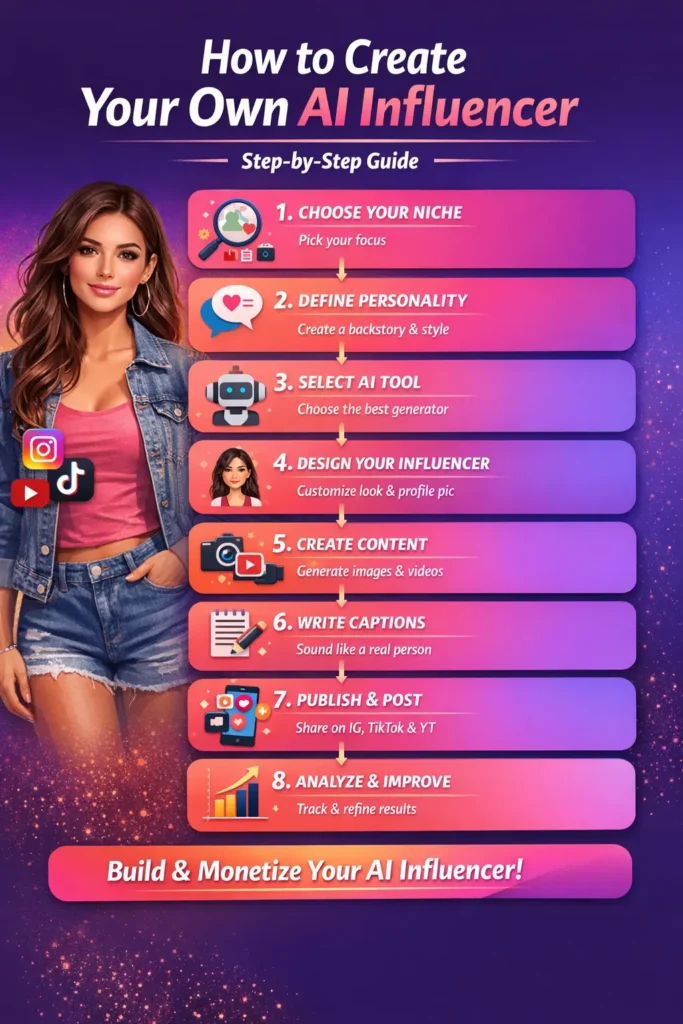
Step 1: Decide the Niche for Your AI Influencer
Before touching any AI influencer generator, I always start with clarity.
Ask yourself:
Who is this AI influencer for?
What problem or interest will they focus on?
Where will they post content?
Some niches that consistently perform well:
Fashion and lifestyle
Fitness and wellness
Tech and gadgets
Travel and luxury
Beauty and skincare
Choosing a clear niche makes your AI generated influencer feel intentional instead of random. It also helps algorithms understand your content faster.
Step 2: Define the Personality and Identity
This step is what separates low-effort profiles from believable ones.
I always give my AI influencer:
A name
A personality (confident, friendly, aesthetic, informative)
A short backstory
A clear tone of voice
When you use an AI influencer generator, this information helps guide the visuals, expressions, and future content. The more specific you are, the more human your influencer feels.
Step 3: Choose the Right AI Influencer Generator
Not all tools are built the same. From my experience, the best AI influencer generators allow you to:
Keep the same face consistent across posts
Generate both images and videos
Create content optimized for Instagram, TikTok, and YouTube
When you’re starting out, I recommend using one AI influencer generator and learning it well instead of jumping between tools. Consistency matters more than perfection.
Step 4: Create the AI Influencer Character
Now comes the fun part — actually creating your influencer.
Inside the AI influencer generator, you’ll usually:
Select physical traits like age, style, and overall look
Choose outfits and aesthetics that match your niche
Generate a high-quality profile image
This profile image becomes the face of your brand. I always regenerate until it looks realistic enough that someone would believe it’s a real person.
Step 5: Generate AI Influencer Images and Videos
Once the character is ready, I move on to content creation.
Most modern AI influencer generators let you:
Create lifestyle images
Generate product-style photos
Produce short vertical videos
If your tool supports it, try creating AI influencer video generator content early. Short videos perform far better than static images on most platforms.
I usually create:
3–5 profile images
5–10 lifestyle posts
3 short videos for Reels or Shorts
This gives me enough content to launch confidently.
Step 6: Write Captions That Match the Influencer
This is where many people go wrong.
Even the best AI generated influencer can feel fake if the captions don’t sound human. I always write captions as if the influencer themselves is speaking.
Use:
Simple language
Emojis (but not too many)
Short paragraphs
Clear calls to action
This step alone can double engagement.
Step 7: Publish on Instagram, TikTok, and YouTube
Once content is ready, it’s time to post.
From what I’ve seen, AI influencers perform best on:
Instagram Reels
TikTok
YouTube Shorts
Post consistently, even if engagement is low at first. Algorithms need time to understand your content. I usually recommend posting at least once per day for the first 30 days.
Step 8: Analyze What Works and Improve
After publishing, I pay close attention to:
Which posts get saved
Which videos get watch time
What comments people leave
Then I feed those insights back into the AI influencer generator and create more of what works. This feedback loop is how AI influencers grow fast.
My Personal Tips for Better Results
From my experience:
Stick to one niche early
Don’t change the influencer’s face often
Focus on short-form video
Treat your AI influencer like a real brand
Be patient — results compound
My Final Advice
Creating your own AI influencer isn’t about shortcuts. It’s about using the right AI influencer generator to build something scalable, consistent, and monetizable.
If you follow this step-by-step process, you won’t just create an AI generated influencer — you’ll create a digital asset that can grow, earn, and evolve over time.
AI Influencer Generator for Instagram, TikTok & YouTube
From my experience, AI influencers perform best on platforms where short-form, personality-driven content dominates. That’s why Instagram, TikTok, and YouTube are the top platforms where an AI influencer generator can actually deliver results.
Each platform rewards slightly different behavior, and the good news is that modern AI influencer generators are built specifically with these platforms in mind.
On Instagram, AI influencers work extremely well for Reels, lifestyle posts, and product-style content. I’ve seen AI-generated influencers outperform real creators in engagement simply because the visuals are consistent, polished, and niche-focused. With the right AI influencer generator, you can create Instagram-ready content without worrying about lighting, locations, or photoshoots.
On TikTok, short-form video is king. This is where AI influencer video generators shine. If your AI influencer can express emotions, react to trends, or present products naturally, TikTok’s algorithm often pushes that content aggressively. I’ve personally found TikTok to be the fastest platform for testing new AI influencer concepts.
On YouTube, AI influencers work best through Shorts and niche explainers. While long-form YouTube still favors human creators, AI-generated influencers are surprisingly effective for Shorts, motivational clips, tech reviews, and faceless brand storytelling.
The key takeaway here is simple: a good AI influencer generator should support vertical video formats and consistent characters across all three platforms. If it doesn’t, you’ll hit a growth ceiling fast.
Key Features to Look for in the Best AI Influencer Generator
After testing multiple tools, I’ve learned that not every platform that claims to be an AI influencer generator is actually useful for long-term growth or monetization. Here’s what I personally look for before recommending any tool.
First, character consistency is non-negotiable. The best AI influencer generators allow you to reuse the same face, expressions, and personality across posts. If your influencer looks different in every image, your audience won’t trust it.
Second, realistic visuals matter more than fancy features. Over-stylized or cartoonish outputs rarely perform well. A strong AI generated influencer should look like a real person scrolling past someone’s feed.
Third, video generation support is essential. Static images alone won’t cut it anymore. Whether it’s Reels, TikTok videos, or Shorts, your AI influencer generator should support motion, expressions, and natural gestures.
Fourth, platform optimization saves time. The best tools generate content already sized and optimized for Instagram, TikTok, and YouTube, so you don’t need extra editing tools.
Finally, scalability is often overlooked. A good AI influencer generator should let you create content in batches. If you plan to monetize, you’ll need volume and consistency.
AI Influencer vs Human Influencer: Which Performs Better?
This is one of the most common questions I get, and the honest answer is: it depends on the goal.
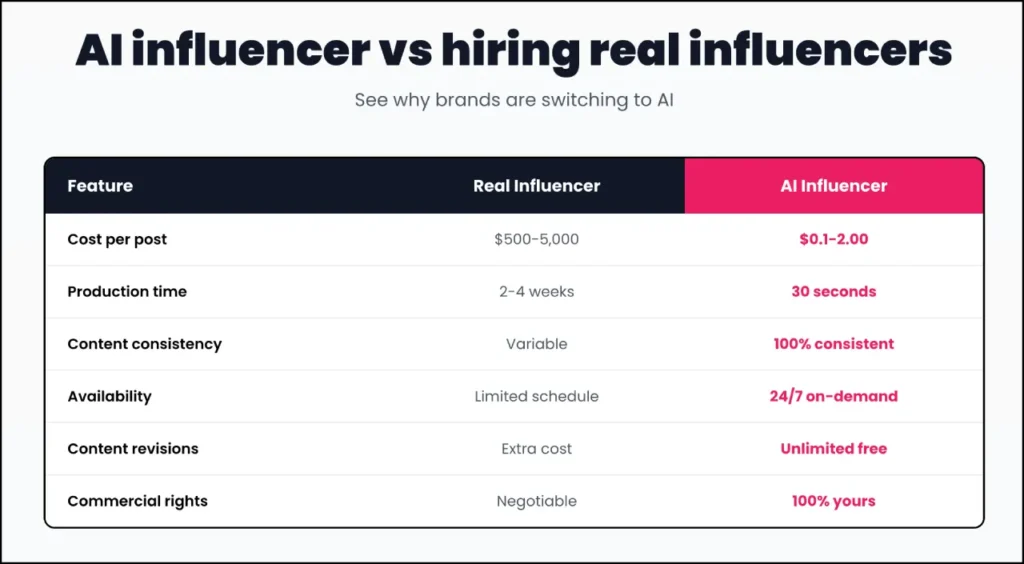
From a branding and trust perspective, human influencers still hold an edge in storytelling and emotional connection. However, when it comes to consistency, cost, and scalability, AI influencers outperform humans by a wide margin.
An AI influencer never misses a post, never raises rates, never burns out, and never goes off-brand. That alone makes AI influencers incredibly attractive for affiliate marketers and brands.
In my own testing, I’ve seen AI-generated influencers achieve comparable engagement rates to micro-influencers, especially in niches like fashion, tech, lifestyle, and motivation. For UGC-style content and paid ads, AI influencers often perform better because the visuals are controlled and repeatable.
Where AI influencers struggle is deep emotional storytelling or live interactions. But for most monetization strategies, that limitation doesn’t matter.
If your goal is scale, automation, and predictable content, an AI influencer generator is often the better choice.
How AI Influencers Make Money (Real Monetization Examples)
One of the biggest misconceptions is that AI influencers are just for fun. In reality, they are powerful monetization assets when used correctly.
The most common method I use is affiliate marketing. An AI influencer promotes tools, products, or services through captions, bio links, or video overlays. Because the content looks professional and niche-focused, conversion rates can be surprisingly strong.
Another effective model is UGC-style brand deals. Brands don’t always care if the influencer is real. They care about content quality. Many brands now pay for AI-generated influencer content that they can reuse in ads.
Some creators monetize through digital products, using AI influencers to promote ebooks, courses, or subscriptions. Others build themed accounts and sell shoutouts once the page grows.
There’s also faceless monetization, where the AI influencer becomes the “face” of a niche page, while all operations remain anonymous.
The key thing I’ve learned is this: AI influencers are not get-rich-quick schemes, but they are scalable digital assets when paired with the right strategy and consistency.
Pros and Cons of Using AI Influencer Generators
Like any tool, AI influencer generators come with advantages and limitations. Based on my experience, here’s the honest breakdown.
Pros
No filming, photoshoots, or models needed
Lower long-term cost compared to human influencers
Unlimited content creation
Perfect brand consistency
Scales easily across platforms
Cons
Requires learning prompts and workflows
Can feel generic if poorly customized
Some audiences still prefer human creators
Tool limitations depend on the platform you choose
When used strategically, the pros far outweigh the cons. Most failures I’ve seen come from poor execution, not from the technology itself.
Are AI Influencer Generators Legal and Safe to Use?
This is an important question, and one I always take seriously.
In general, AI influencer generators are legal to use, as long as you follow platform rules and ethical guidelines. Most reputable tools grant you commercial usage rights for generated content, but I always recommend checking each platform’s terms.
Where people get into trouble is impersonation. Your AI generated influencer should be clearly fictional and not resemble real public figures.
From a safety standpoint, using a well-known AI influencer generator is far safer than stitching together random AI tools. Established platforms handle data responsibly and provide clear content usage rights.
Transparency is also important. While you don’t always need to announce that an influencer is AI, you should avoid misleading claims or deceptive practices.
Frequently Asked Questions About AI Influencer Generators
What is an AI influencer generator?
An AI influencer generator is a tool that helps you create realistic digital influencers using artificial intelligence.
Can I use a free AI influencer generator?
Yes, several platforms offer free or trial versions, though advanced features usually require paid plans.
Do AI influencers work on Instagram and TikTok?
Yes. AI influencers perform especially well on Instagram Reels and TikTok when content is consistent and niche-focused.
Can AI influencers make money?
Absolutely. Many creators earn through affiliate marketing, UGC deals, and brand collaborations.
Is it safe to use AI influencer generators?
Yes, as long as you use reputable tools and follow usage guidelines.
My Final Verdict: Best AI Influencer Generator to Choose
After everything I’ve tested and learned, here’s my honest conclusion.
The best AI influencer generator is the one that lets you:
Create consistent, realistic influencers
Generate both images and videos
Scale content across Instagram, TikTok, and YouTube
Monetize without unnecessary complexity
If you’re serious about building a long-term asset, I recommend choosing one strong AI influencer generator, mastering it, and focusing on content strategy rather than chasing tools.
AI influencers aren’t a trend. They’re a new category of digital creators. And if you approach this strategically, you’re not just creating content — you’re building a scalable brand.