
AI influencer generators are transforming how creators and brands build digital personalities for social media, ads, and content monetization. With the right AI influencer generator, you can create hyper-realistic AI influencers, produce engaging videos, and scale UGC content — without ever hiring a model or stepping in front of a camera.
In this guide, I compare the best AI influencer generators available in 2026, including free options, video-focused platforms, and Instagram-ready solutions. You’ll learn exactly how to create your own AI influencer, which features matter most, and which tools offer the best value for affiliate marketing, brand deals, and content monetization.
Quick Pick: If you want my #1 recommendation right now — ReelMoney is the fastest way to go from zero to a live AI influencer. ZenCreator is the best all-around platform if you want image + video + long-term consistency.
Whether your goal is building an AI influencer for Instagram, creating AI-generated influencer videos for TikTok, or learning how AI influencers make money — this page has everything you need.
What Is an AI Influencer? (And Why Everyone’s Building One)
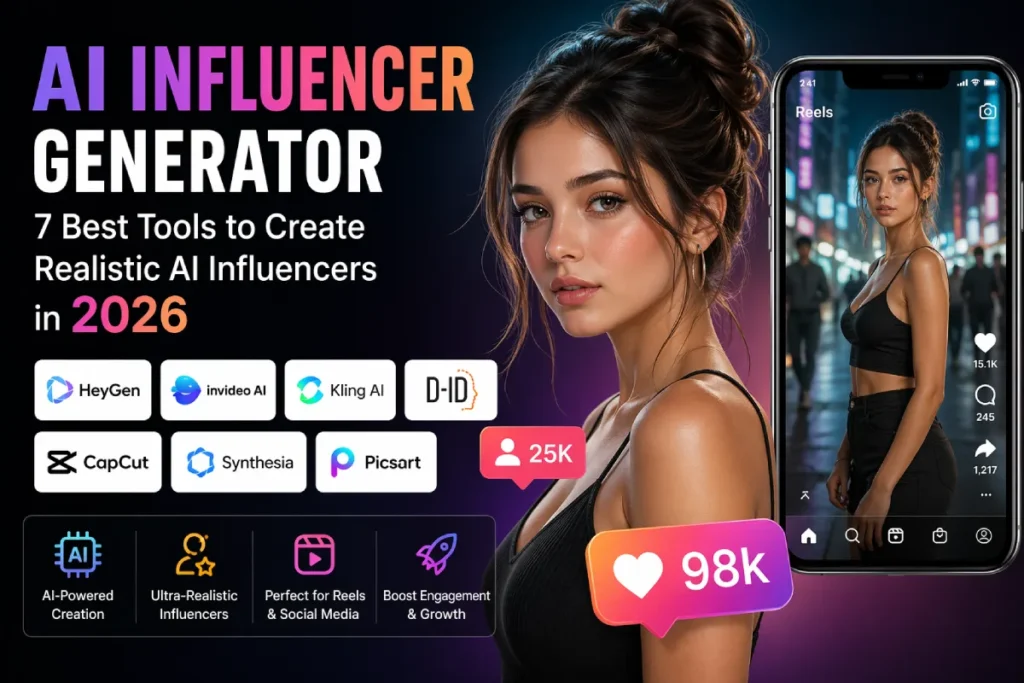
An AI influencer is a computer-generated virtual persona that produces realistic images and videos for social media, ads, and brand campaigns. Unlike stock imagery, AI influencers maintain a consistent face, style, and personality across every single post.
The numbers tell the story: the AI influencer market was valued at $6.95 billion in 2024 and is projected to reach $52.10 billion by 2033. Brands like Prada, Samsung, and Calvin Klein have already partnered with virtual influencers to slash production costs by 30–50% compared to human talent.
The biggest reason creators are jumping in right now? According to a 2025 HypeAuditor report, virtual influencer posts receive 3x higher engagement rates than equivalent human influencer content. That gap is only widening.
If you’ve been thinking about building a side income online, this is one of the most scalable digital assets you can create in 2026. For context, I also cover this in my guide on how to become a content creator — AI influencers fit perfectly into that model.
Top AI Influencer Generators Reviewed (In-Depth)
When I first started testing AI influencer generators, I quickly realized one thing: not all tools that claim to create AI influencers are actually built for real-world use. Some are just image generators. Others look impressive in demos but fall apart when you try to create consistent content or monetize it.
So instead of listing random tools, I focused on platforms that actually help you create, scale, and monetize AI influencers — whether your goal is Instagram growth, UGC ads, affiliate marketing, or brand deals.
Below, I’m sharing what worked, what didn’t, and which AI influencer generators are genuinely worth your time and money.
1. ReelMoney — Best for Fast AI Influencer Creation
⭐ Top Pick for Speed & Beginners
When speed matters, ReelMoney really shines.
I found ReelMoney especially useful when I wanted to quickly test niches or create short-form influencer content without spending hours tweaking settings. You can go from idea to live AI influencer content in minutes — which is perfect if you’re focused on Instagram Reels, TikTok, or YouTube Shorts.
The platform walks you through the process step by step, making it ideal if you’re new to AI influencers or don’t want to deal with complex controls.
What I liked:
- Very fast AI influencer creation — minutes, not hours
- Simple guided interface with clear steps
- Good balance between automation and customization
- Free trial available before you upgrade
Limitations:
- Less advanced customization compared to full creative suites
- Best suited for short-form content rather than cinematic videos
Best for: Anyone who wants to create AI influencers quickly and publish consistently. Try ReelMoney Free →
2. ZenCreator — Best Overall AI Influencer Generator
⭐ Top Pick for Long-Term Brands
If you’re looking for the most complete AI influencer generator on the market, ZenCreator is where I’d start.
What I like most about ZenCreator is that it doesn’t just generate a face and stop there. You can create consistent AI influencers, generate multiple images and videos, and reuse the same character across different posts and campaigns. That consistency is critical if you want your AI influencer to feel real and recognizable over time.
I also appreciate that ZenCreator offers a real free tier — no credit card required — which makes it perfect if you’re still experimenting or validating a niche idea.
Why ZenCreator works so well:
- Create both AI influencer images and videos in one platform
- Same AI influencer face reused consistently across all posts
- Outputs optimized for Instagram, TikTok, and YouTube formats
- Batch generation to produce multiple content variations at once
- Face swap + lip sync included on paid plans
Where it can improve:
- Advanced video features are locked behind paid plans
- You’ll need some trial and error to master the best prompts
Best for: Creators who want a long-term AI influencer brand, not just a one-off image. Try ZenCreator Free →
3. HeyGen — Best for AI Influencer Videos & Talking Avatars
If your AI influencer needs to speak on camera, HeyGen is the standout choice.
HeyGen combines AI facial animation and voice synthesis to create avatars that speak naturally, look believable on video, and can present scripted content with real gestures and expressions. The workflow is simple: upload a reference image, write a script, and export a talking-head video in minutes.
Strengths:
- Industry-leading lip-sync and voice quality
- Supports 40+ languages — great for global campaigns
- Clean, polished video output suitable for ads and YouTube
Weaknesses:
- Doesn’t replace a full image-generation platform
- Paid plans are required for watermark-free HD output
Best for: AI influencers that need to deliver scripted video content, tutorials, or product demos.
4. Quickads AI — Best for Creative Control & Campaign Content
If your focus is creative freedom and visual control, Quickads AI is worth exploring.
I found Quickads especially useful when designing influencer visuals for ads and branded content. You can control poses, styles, moods, and overall aesthetics far more precisely than with beginner-focused tools.
Strengths:
- High level of visual customization for brand-specific looks
- Great for product-focused influencer content and UGC campaigns
- Scales well for ad testing and multi-variant creative
Weaknesses:
- Less beginner-friendly — you need a clear vision to use it well
- More focused on visuals than full end-to-end influencer workflows
Best for: Marketers and brands running UGC-style ad campaigns who already know what they want.
5. JoggAI — Best for E-Commerce & Product Promotions
JoggAI is purpose-built for e-commerce sellers and product marketers who need an AI influencer that can demonstrate, review, and promote physical products naturally.
What sets JoggAI apart is its URL-to-Video feature — paste your product URL and it generates a product demo video with an AI influencer in minutes. Perfect for scaling ad creative without a studio.
Strengths:
- 500+ diverse avatar templates to start from
- URL-to-video saves hours of manual scripting
- Strong face consistency across long-term campaigns
Weaknesses:
- Less suited for organic lifestyle content
- Pricing is higher than beginner tools
Best for: Shopify sellers, Amazon sellers, and brand marketers who need AI influencer product videos at scale.
6. Synthesia — Best for Enterprise & Multilingual Campaigns
Synthesia is the enterprise-grade choice for teams running professional video campaigns across multiple markets and languages.
If you’re building AI influencer content for training, corporate communications, or global ad campaigns in 50+ languages, Synthesia delivers a level of polish and reliability that smaller tools can’t match.
Best for: Enterprise teams and agencies running high-volume, multilingual video production.
7. LucidPic — Best Budget Option for Image-Focused Creators
LucidPic offers a cost-effective entry point for creators who primarily need high-quality AI influencer images rather than videos. Plans start from just $8/month, making it one of the most accessible options for beginners on a tight budget.
Best for: Budget-conscious creators focused on static image content for Instagram and Pinterest.
Best Free AI Influencer Generator (For Beginners)
A lot of people ask me: “Is there a free AI influencer generator that actually works?”
From my testing, ZenCreator’s free tier is one of the few that genuinely lets you experiment without forcing payment upfront. You can also check out APOB AI, which gives 80 free daily credits — renewable every day — so you can keep refining your influencer concept without any time pressure.
With either free option, you can:
- Test different influencer styles and looks
- Understand how AI influencer creation actually works
- Validate your niche before investing money
Best use case: Learning, early-stage testing, and niche validation before scaling up. Start Free with ZenCreator →
Top AI Influencer Generators Compared — Features, Pricing & Best Use (2026)
| Tool | Best For | Pricing | Free Option |
|---|---|---|---|
| ReelMoney | Fast creation & TikTok/Instagram growth | From $29/month | Free Trial |
| ZenCreator | Best all-around platform | From $19/month | Free Tier (no card) |
| HeyGen | Video-centric AI influencers | From $29/month | Free Trial |
| JoggAI | E-commerce & product videos | From $29/month | Limited Trial |
| Quickads AI | Ad campaigns & creative control | Plans vary | Free Exploration |
| Synthesia | Enterprise & multilingual video | From $29/month (custom enterprise) | Free Trial |
| LucidPic | Budget image-focused creators | From $8–$96/month | No |
Real Examples of Successful AI Influencers
Before you build your own, it helps to see what’s already working at scale. Here are a few notable virtual influencers proving the concept:
- Lil Miquela — 2.6M+ Instagram followers. Has collaborated with Prada, Calvin Klein, and Samsung. Earns an estimated $10M+ per year.
- Aitana López — Spain’s first AI influencer, with 350K+ Instagram followers. Created by a modeling agency to replace expensive human models.
- Lu do Magalu — Brazil’s most-followed virtual influencer, with 8M+ followers across platforms. Acts as a brand ambassador for Magazine Luiza.
These aren’t fringe experiments. They’re proof that AI influencers are a legitimate, scalable income channel when built with the right strategy.
How to Create Your Own AI Influencer (Step-by-Step)
Anyone can create their own AI influencer using the right AI influencer generator — even with zero design or video experience. Here’s the exact process I follow.
Step 1: Choose Your Niche
Before touching any tool, start with clarity. Ask yourself: Who is this AI influencer for, and what will they consistently post about?
High-performing AI influencer niches include:
- Fashion and lifestyle
- Fitness and wellness
- Tech and gadgets
- Travel and luxury
- Beauty and skincare
A clear niche makes your AI influencer feel intentional rather than random — and helps platform algorithms push your content faster.
Step 2: Define the Persona and Identity
This is what separates forgettable profiles from believable digital personalities. Give your AI influencer:
- A unique name
- A defined personality (confident, friendly, aspirational, informative)
- A short backstory
- A consistent tone of voice
The more specific you are, the more human your influencer feels. This information also guides every creative decision you make inside the generator.
Step 3: Choose the Right AI Influencer Generator
Not all tools are built the same. Based on my testing, here’s the quick decision framework:
- Want to start fast and test a niche? → ReelMoney
- Want the most complete image + video platform? → ZenCreator
- Need your influencer to talk on camera? → HeyGen
- Running product ads at scale? → JoggAI
Pick one tool and learn it well. Consistency matters more than perfection in the early stages.
Step 4: Generate the AI Influencer Character
Inside the generator, you’ll typically:
- Select physical traits: age range, skin tone, hair style, aesthetic
- Choose outfits and environments that match your niche
- Generate and iterate until you have a profile image that looks completely believable
I always regenerate until the output could pass as a real person’s profile photo. That’s your benchmark.
Step 5: Create Images and Videos
Once your character is locked in, move to content production. Aim to build:
- 3–5 high-quality profile/headshot images
- 5–10 lifestyle posts matching your niche
- 3 short vertical videos for Reels or TikTok Shorts
Short-form video consistently outperforms static images across all platforms in 2026. Prioritize it from day one.
Step 6: Write Captions That Sound Human
Even the best-looking AI influencer will feel robotic with stiff captions. Write as if the influencer themselves is speaking:
- Use simple, direct language
- Include 1–3 relevant emojis
- Keep paragraphs short (2–3 lines max)
- End with a soft call to action
This step alone can double your engagement rate.
Step 7: Publish Consistently on Instagram, TikTok, and YouTube
AI influencers perform best on:
- Instagram Reels — for discovery and visual lifestyle content
- TikTok — fastest platform for algorithm-driven growth
- YouTube Shorts — for longer-term SEO value and evergreen reach
Post at least once per day for the first 30 days. Algorithms need time to categorize your content. Early consistency is what triggers initial growth.
Step 8: Analyze, Iterate, and Scale
After 2–3 weeks of publishing, check:
- Which posts get saved (signals content value)
- Which videos get watch time past 50% (signals algorithm preference)
- What comments reveal about audience interest
Feed those insights back into your generator and create more of what works. This feedback loop is how AI influencers grow fast.
AI Influencer Generator for Instagram, TikTok & YouTube
From my experience, AI influencers perform best on platforms where short-form, personality-driven content dominates. Here’s what works on each platform specifically:
On Instagram: AI influencers work extremely well for Reels, lifestyle posts, and product-style content. Consistent, polished visuals often outperform real creators in pure engagement metrics because there’s no bad lighting, no off-brand posts, and no inconsistency. An AI influencer generator that exports in the correct Instagram ratios (4:5 for feed, 9:16 for Stories and Reels) saves you hours.
On TikTok: Short-form video is king, and the algorithm rewards consistency more than follower count. If your AI influencer can express emotions, react to trends, or demonstrate products naturally, TikTok’s algorithm pushes that content hard. I’ve found TikTok to be the fastest platform for testing new AI influencer concepts.
On YouTube: AI influencers work best for Shorts and niche explainers. Long-form YouTube still favors human creators, but AI-generated content is surprisingly effective for Shorts, product reviews, and faceless educational channels. If you’re also running an autoblogging or content automation strategy, check out my guide on autoblogging — AI influencers pair naturally with that workflow.
The rule of thumb: your AI influencer generator must support vertical video and maintain character consistency across all platforms. Without both, you’ll hit a growth ceiling fast.
Key Features to Look For in the Best AI Influencer Generator
After testing multiple tools, here’s what I personally look for — and what I recommend you prioritize:
1. Character consistency (most important) The best AI influencer generators allow you to reuse the same face, expressions, and style across every post. If your influencer looks different in each image, audiences won’t trust it.
2. Realistic, photographic-quality visuals Over-stylized or obviously AI-generated outputs don’t perform well on social media. Your AI influencer should look like a real person — the kind that passes without a second look in a feed scroll.
3. Video generation support Static images alone won’t build a following in 2026. Look for tools that support motion, realistic lip-sync, and vertical video formats natively.
4. Platform optimization The best tools generate content pre-sized for Instagram, TikTok, and YouTube — 1:1, 4:5, and 9:16 aspect ratios — so you don’t need a separate editing app.
5. Scalability and batch generation If you plan to monetize, you need volume. A good AI influencer generator should let you create multiple content variations in one session, not just one image at a time.
AI Influencer vs Human Influencer: Which Performs Better?
This is one of the most common questions I get. The honest answer: it depends on what you’re optimizing for.
| Factor | AI Influencer | Human Influencer |
|---|---|---|
| Content consistency | ✅ Never goes off-brand | ❌ Varies with mood/life |
| Cost at scale | ✅ Fixed monthly tool cost | ❌ Rates increase with reach |
| Emotional storytelling | ❌ Limited depth | ✅ Strong authentic connection |
| Availability | ✅ 24/7, any location, any outfit | ❌ Requires scheduling |
| Brand control | ✅ Complete | ❌ Partial |
| Engagement rate | ✅ Up to 3x higher (per HypeAuditor) | Variable |
In my own testing, AI-generated influencers achieve comparable engagement rates to micro-influencers in niches like fashion, tech, lifestyle, and motivation. For UGC-style content and paid ads, AI influencers often perform better because the visuals are controlled and repeatable.
Where AI influencers struggle is deep emotional storytelling and live interaction. But for most monetization strategies — affiliate marketing, UGC deals, product promotions — that limitation rarely matters.
If your goal is scale, automation, and predictable content output, an AI influencer generator is the stronger business choice.
How AI Influencers Make Money (Real Monetization Models)
One of the biggest misconceptions is that AI influencers are just for fun. In reality, they are powerful monetization assets when built with a clear strategy. Here’s how creators are actually earning:
1. Affiliate Marketing The most common model. Your AI influencer promotes tools, products, or services through captions, bio links, or video overlays. Because the content looks professional and niche-focused, conversion rates are surprisingly strong. This is the same strategy covered in my guide on AI SEO tools — the distribution method is different, but the income mechanics are identical.
2. UGC-Style Brand Deals Brands don’t always care if the influencer is real. They care about content quality. Many brands now pay $200–$2,000+ per AI-generated content piece that they can reuse in paid ads.
3. Digital Products Use your AI influencer to promote and sell ebooks, online courses, Notion templates, or digital downloads. The influencer handles awareness; you handle fulfillment.
4. Faceless Niche Accounts Build a themed AI influencer account, grow the page, then monetize through affiliate commissions, shoutout sales, or sponsored posts — completely anonymously. This pairs well with a broader content creation strategy.
5. Social Media Monetization Programs TikTok’s Creator Rewards Program and YouTube Shorts monetization both pay based on views. AI influencers that post consistently can qualify and earn passive income from platform ad revenue.
Key takeaway: AI influencers are not a get-rich-quick scheme. But they are scalable digital assets that compound over time when paired with consistent strategy.
How Much Does an AI Influencer Generator Cost?
Here’s the real cost breakdown so you can budget before committing:
- Free tiers: ZenCreator (no card required), APOB AI (80 daily free credits) — good for testing
- Entry-level paid: LucidPic from $8/month, ZenCreator Pro from $19/month
- Mid-range: ReelMoney from $29/month, HeyGen from $29/month, JoggAI from $29/month
- Enterprise: Synthesia custom pricing for large teams
For context, hiring a real micro-influencer for one campaign can cost $500–$5,000+. An AI influencer generator at $19–$29/month gives you unlimited content creation for a fraction of that cost.
My recommendation: Start with ZenCreator’s free tier. Upgrade once you’ve validated your niche and content style. Start for Free →
Pros and Cons of Using AI Influencer Generators
Like any tool, AI influencer generators come with real advantages and real limitations.
Pros:
- No filming, photoshoots, or model contracts needed
- Lower long-term cost vs. human influencer partnerships
- Unlimited content creation — no creative burnout
- Perfect brand consistency across every post
- Scales easily from 10 posts to 1,000 posts per month
Cons:
- Requires learning prompts and creative workflows
- Can feel generic if poorly customized
- Some audiences still prefer human creators
- Platform disclosure rules are evolving (Instagram and TikTok increasingly require AI content labels)
When used strategically, the pros far outweigh the cons. Most failures I’ve seen come from poor niche selection and inconsistent posting — not from the technology itself.
Are AI Influencer Generators Legal and Safe to Use?
In general, AI influencer generators are legal to use, provided you follow platform rules and ethical guidelines. Most reputable tools grant commercial usage rights for generated content — but always check each platform’s specific terms before monetizing.
Where people get into trouble:
- Creating AI influencers that resemble real, identifiable public figures
- Failing to disclose AI-generated content where required by platform policy (Instagram and TikTok now require labels in many regions)
- Using tools without commercial rights for paid promotions
From a practical safety standpoint, using a well-known AI influencer generator like ZenCreator or ReelMoney is far safer than stitching together random free AI tools. Established platforms handle data securely and provide clear commercial usage rights.
Bottom line: Be transparent, stay fictional, and always read the terms. AI influencer marketing is a legitimate industry — treat it like one.
Frequently Asked Questions About AI Influencer Generators
What is an AI influencer generator? An AI influencer generator is a software tool that uses artificial intelligence to create realistic digital personas — complete with consistent faces, customizable personalities, and the ability to generate both images and videos for social media use.
What is the best free AI influencer generator? ZenCreator’s free tier is the strongest option for beginners — no credit card required. APOB AI also offers 80 renewable daily free credits. Both let you validate your concept before paying anything.
Do AI influencers work on Instagram and TikTok? Yes. AI influencers perform especially well on Instagram Reels and TikTok when content is consistent, niche-focused, and posts regularly. Virtual influencer content gets up to 3x higher engagement than equivalent human content, according to HypeAuditor’s 2025 data.
Can AI influencers make real money? Absolutely. Revenue streams include affiliate marketing, UGC brand deals, digital product sales, faceless niche accounts, and platform monetization programs. The key is treating it as a long-term content asset, not a quick win.
How long does it take to create an AI influencer? With a tool like ReelMoney or ZenCreator, you can create your first AI influencer character and generate a starter content pack in under 2 hours. Growing an audience takes 30–90 days of consistent posting.
Do I need to disclose that my influencer is AI-generated? Platform policies are evolving rapidly. Instagram and TikTok increasingly require AI-generated content labels in many regions. Being transparent about your virtual influencer builds trust and avoids potential account penalties. Many successful AI influencer accounts are openly virtual.
Is it safe to use AI influencer generators? Yes, as long as you use reputable platforms that provide commercial usage rights and you follow the ethical and legal guidelines above.
My Final Verdict: Best AI Influencer Generator to Choose
After everything I’ve tested and learned, here’s my honest conclusion.
The best AI influencer generator is the one that lets you:
- Create consistent, realistic influencers with a locked face across all content
- Generate both images and videos in one platform
- Scale content across Instagram, TikTok, and YouTube
- Monetize without unnecessary technical complexity
My top picks in 2026:
| Goal | My Pick |
|---|---|
| Start fast, test a niche | ReelMoney |
| Best overall platform | ZenCreator |
| Video & talking avatars | HeyGen |
| Product/e-commerce ads | JoggAI |
| Enterprise campaigns | Synthesia |
| Budget image creation | LucidPic |
If you’re serious about building a long-term asset, my advice is simple: pick one AI influencer generator, master it, and focus on content strategy rather than tool-hopping.
AI influencers aren’t a trend. They’re a new category of digital creator — one that gives anyone, regardless of how they look or where they live, the ability to build a scalable online brand.
Ready to start? → Try ReelMoney Free | Try ZenCreator Free
Related Guides on Webseotrends
- How to Become a Content Creator: My 8-Year Proven Guide
- I Tested 15 AI SEO Tools. Here Are the Ones That Actually Work in 2026
- How to Start a Blog in 2026
- Autoblogging: How to Automate Your Content Strategy
This page contains affiliate links. If you click a link and make a purchase, we may earn a small commission at no extra cost to you. We only recommend tools we have personally tested or thoroughly researched. Thank you for supporting Webseotrends.
